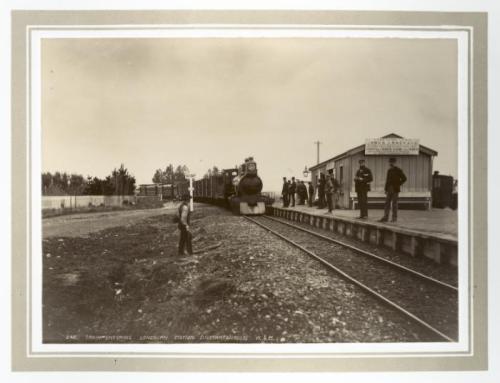
 As Lois Hall outlines in her history of the Pohangina Valley, large areas of open grassland such as those found in Canterbury and eastern Hawkes Bay had been quickly settled in the 1840s and 1850s, mainly by more wealthy settlers. But by the latter part of the nineteenth century, the government turned its focus to the provision of land for the settlement of those of lesser means and the descendants of the original settlers who sought to own their own farms. Attention turned to regions that were still forested and undeveloped, such as the Manawatu and western Hawkes Bay. Continue reading
commentary

Papaitonga – hidden jewel of Horowhenua
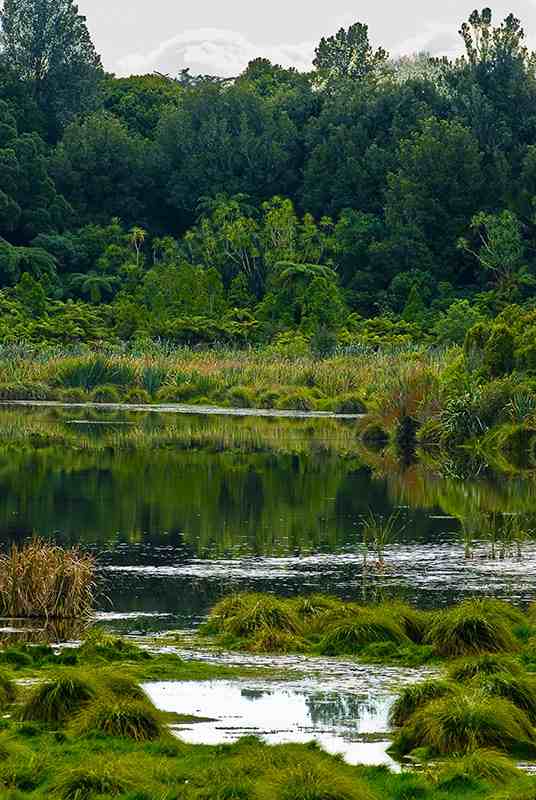 Papaitonga is a dune lake in the Horowhenua coastal plain. It is surrounded by a very rare remnant of coastal north island forest. Just south of Levin, the 135 hectare Papaitonga Scenic Reserve is a little known but ecologically and historically remarkable place [click here to view map].
The reserve contains the only intact sequence from wetland to mature dry terrace forest in Wellington and Horowhenua. It is an important refuge for birds that depend on wetlands or lowland forests for their survival. Papaitonga is home to waterfowl and wading birds as well as forest species on the lake’s margins. However, like many remnant wetland forests, the health of this wetland forest is threatened by a receding water table. The reserve is surrounded by farmland which draws on large volumes of water for irrigation. Continue reading
Share this:

From “swamps” to “wetlands”
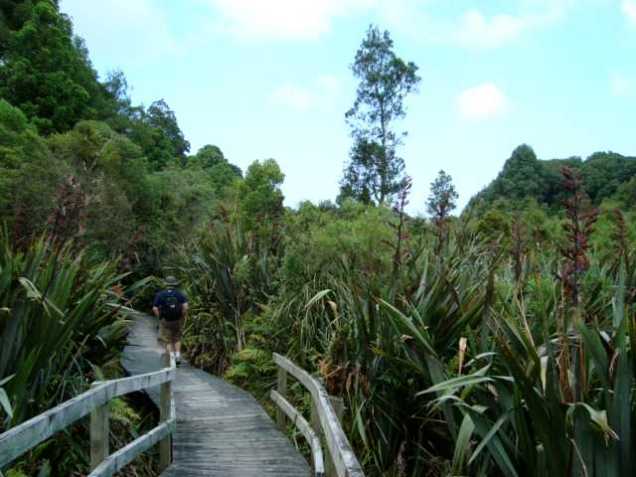 Through time, not only has our environment been transformed, but also the way we perceive it and the words we use to describe it. No example illustrates this better than the “swamp” to “wetland” transformation. When European settlement of New Zealand began in earnest about 150 years ago, about 670,000 hectares of freshwater wetlands existed. By the 20th century, this had been reduced to 100,000 hectares. Continue reading
Share this:

Totara Reserve: from exploitation to conservation
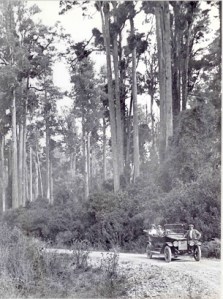 Totara Reserve is situated in the Pohangina Valley on the eastern side of the Pohangina River, in the Manawatu [click here to view location]. It encompasses an area of 348 hectares, much of it podocarp forest, made up of totara, matai, rimu and kahikatea, as well as some black beech.
Its history as a reserve began in 1886, when it was gazetted under the provisions of the State Forests Act (1885) as a ‘reserve for growth & preservation of timber and for river conservation purposes’. This at a time when the area was been ‘opened up’ for settlement – settlement in the Pohangina Valley area began with Ashhurst in March 1879.
In 1932, a portion of the Reserve was designated as a Scenic Reserve under the provisions of the Scenery Preservation Act 1908, and vested in the Pohangina County Council. Continue reading
Share this:

The mysterious case of the disappearing river
 Of the many fascinating stories about New Zealand’s rivers, none would be more mysterious that the case of the disappearing river of Waikanae.
About 120 years ago, the Waimeha River forked off the Waikanae River near the current road bridge south of Waikane township. It then meandered through the current Waikanae township, largely following the route of what is now Te Moana Road. As it neared the coast it sharply changed direction southwards to follow the coastline, before eventually meeting up with the Waikanae River and making its break out to sea. Continue reading
Share this:

Forest degradation and bears
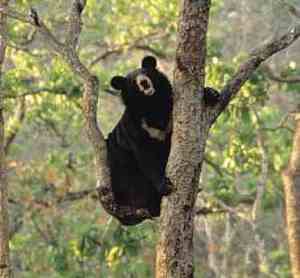 In New Zealand, deforestation has led to chronic erosion, loss of soil fertility and serious floods. However, in other countries, deforestation – or afforestation with plantation species – can lead to a quite different set of problems. Such as bears!
A recent Japan Times article, “Bearing the Brunt”, outlines the problem of increasing human-bear conflict in Japan. The primary author of envirohistory NZ, Catherine Knight, examined the human relationship with bears in Japan through history for her doctoral thesis, and is quoted in this article. She believes that degradation of the bears’ forest habitat is the key factor in the bears’ increasing tendency to encroach into human realms for food. Extreme weather, as a possible result of climate change, is likely to have exacerbated this problem, providing a potential explanation for the recent spikes in bear incidents.
Share this:

Manawatu River – pollution concerns date back to 1890
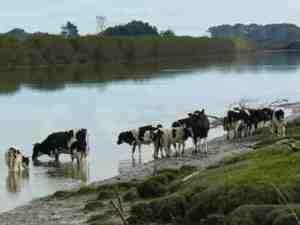 In light of recent media coverage concerning the polluted state of the Manawatu River [click here to view TV news coverage], it is insightful to look back at the river’s history. Even a casual perusal of Papers Past indicates that the vexed issue of pollution of the Manawatu is certainly not a new one.
An article in the Manawatu Herald of 30 May 1890 reports on a meeting held by representatives of local bodies alarmed about Palmerston North Borough Council’s decision to let a contract to discharge the town’s sewerage into the river. The following are two excerpts:
“[Foxton Mayor] Mr Gower said : The business for this meeting to discuss is the fact that the Borough Council of Palmerston N. have let a contract to convey the sewage of that town into the Manawatu river. It will be for us to consider what steps shall be taken to stop such action… Continue reading
Share this:

Important notice to subscribers
You may find that envirohistory nz notifications of new postings or comments at first get diverted to your junk mail folder. You may have to “train” your email application by marking these emails as “not spam”.
Share this:

The “grasslands revolution”
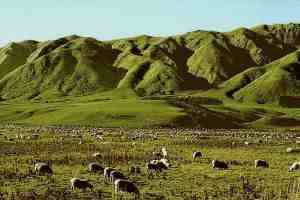 Grass is integral to our agricultural sector, and therefore to our economy. Pasture grasses are exotic species introduced from Europe, and not always suited to our soils or environment. So how is it that pasture-farming has been so successful in New Zealand, despite the relative lack of fertile soils? The answer is phospate-based fertiliser. But another fragile island environment has paid a high price for the artificial fertility of our soils.
As Brooking, Hodge and Wood outline in “The grasslands revolution reconsidered” (Chapter 11, Environmental Histories of New Zealand), the term “grasslands revolution” was coined to celebrate the phenomenal increase in farming productivity which occurred, despite only a small increase in land. Continue reading
Share this:

Destruction of our forests over time
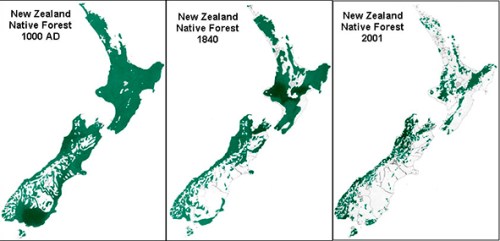
Prior to human colonisation, it is thought that the New Zealand landmass was almost entirely covered in forest, apart from alpine areas. Between the beginning of Polynesian settlement in New Zealand around the fourteenth century and the beginning of organised European colonisation in the nineteenth century, it is estimated that forest cover was reduced by about half, largely through fire. When the European settlement of New Zealand began in earnest in the 1840s, it is estimated that forest, or ‘bush’ in the vernacular, covered about two thirds of the North Island and about 25 to 30 per cent of the South Island. In the decades that followed, bush was destroyed through milling and fire to make way for settlements and farms. By 1900, forest cover had been reduced by half again, to about 25 per cent.
Figure (below): Forest cover AD 1000, 1840, 2001 (Source: Kiwi Conservation Club)