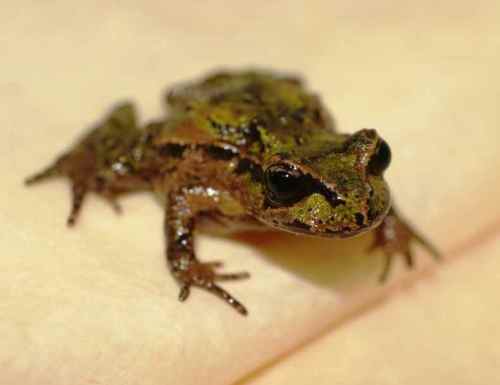
 On top of struggling for their own survival, New Zealand’s native frogs have an additional responsibility on their very little shoulders – being a barometer of forest health. Like other frogs around the world, our frogs are barometers of overall environmental health. That is because frogs breath through very sensitive skin and are more susceptible to disease, pollution and environmental changes. A decline in frog populations is usually an early signal of something awry in the environment – and potential threats to other animals, including people. But in New Zealand, three of our four remaining indigenous frogs are forest-dwellers – preferring shady, moist and undisturbed forests. Therefore, they also act as a measure of the health and distribution of our indigenous forest environments. Continue reading
commentary

Comparing histories – nature conservation in Japan
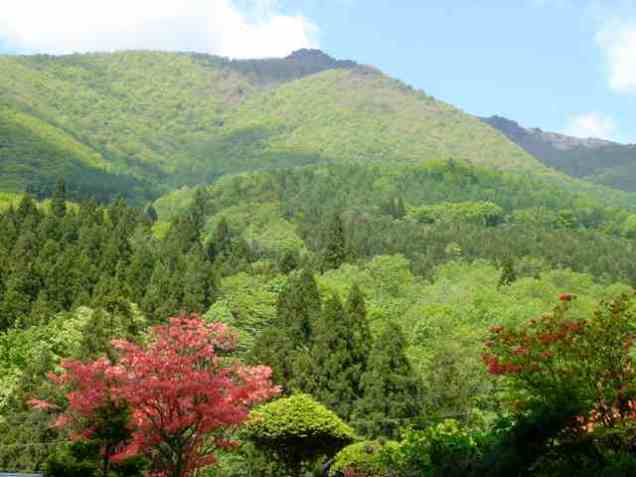
Geographically, Japan and New Zealand are strikingly similar: they are both longitudinally narrow and latitudinally long archipelagos of similar land-mass, and of comparable distance from the respective poles. They are both prone to seismic activity, and predominantly mountainous.
However, unlike New Zealand, Japan’s uplands are still largely forested – about 69 per cent of Japan is under forest, albeit over half of it comprised of exotic coniferous species. Continue reading
Share this:

Back from extinction – the Takahe
 In November 1948, the takahe, which had not been sighted for 50 years and long thought extinct, was discovered in Fiordland’s remote Murchison Mountains. The discovery was made not by a scientist or wildlife specialist, but by Southland medical doctor Geoffrey Orbell. A keen tramper and hunter, Orbell was convinced that the takahe was the source of strange bird calls he had heard when tramping in the area. His tracking and locating of three takahe in 1948 caused an immense stir among the public, and the government quickly closed off this remote part of Fiordland National Park in an effort to protect this last known population.
The excitement this discovery must have caused, among the public and wildlife practitioners alike, is hard to imagine. The following excerpt, from the Southland News in February 1897 – more than half a century before this discovery – demonstrates that even then, most people were resigned to the likelihood that the takahe would follow the same inevitable path to extinction as the huia: Continue reading
Share this:

One landscape – two environmental histories
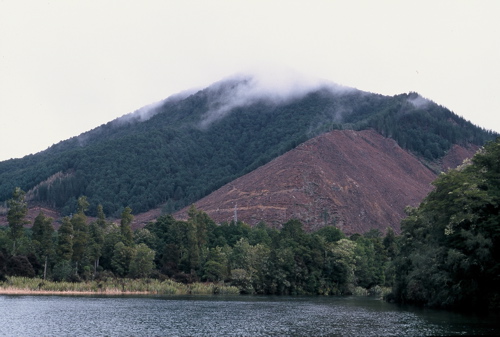 Two environmental histories converge in one landscape. In the foreground is the stunningly beautiful Lake Rotoroa, one of the two lakes in Nelson Lakes National Park, surrounded by wetland vegetation, transitioning into beech forest. In the background is a commercial pine plantation, with one slope scarred by clear-cutting. Nelson Lakes National Park, established in 1956, encompasses 102,000 hectares of the northern most Southern Alps. The lakes were formed by massive glaciers gouging out troughs in the mountainous headwaters of the Buller River during the last Ice Age. The vegetation is predominantly beech, with the red and silver species growing in lower, warmer sites and mountain beech at higher altitudes. The forests are habitat to South Island kaka (a large parrot), tomtits, robins and the tiny rifleman, New Zealand’s smallest bird.
[Photo: Lake Rotoroa, Nelson Lakes National Park, by Rainer Kant]
[Source: Department of Conservation]
Share this:

German voices of dissent against “senseless destruction”
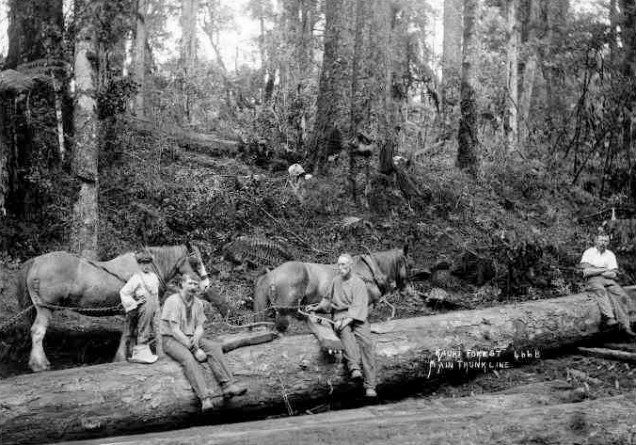 A previous article explored whether Scottish settlers brought with them certain conservationist attitudes and practices [click here to view], but there were also other nationalities that stood out among those urging a more cautious approach to the use of our natural resources in the early years of New Zealand’s European colonisation – one of the most prominent being the German voice.
In Our Islands, Our Selves, David Young introduces a number of German figures who spoke out in protest against what they saw as wasteful and wreckless treatment of New Zealand’s natural resources, including wildlife. Continue reading
Share this:

The Scandinavian settlers of the Manawatu
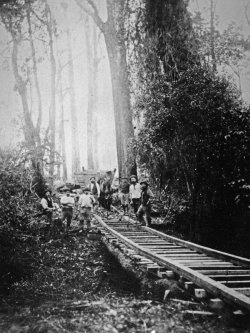 In 1870, Colonial Treasurer Julius Vogel introduced a public works and immigration scheme, under which suitable immigrants would be settled along the projected lines of the road and railway. The idea was that the construction work for this infrastructure would support the settlers until they could develop farms on the blocks of land allotted to them.
At this time, the Manawatu and western Hawkes Bay was still largely undeveloped, in most part covered in dense impenetrable forest. For these areas, Vogel was keen to recruit settlers from Scandinavia, who were reputed for their skill as foresters and axemen. It also appears that he may have also been influenced by an early, and rather illustrious settler in the Manawatu – Ditlev Gothard Monrad, former premier of Denmark. Monrad had immigrated to New Zealand, along with his family, in 1866, in a kind of self-imposed exile. Clearly not afraid of hard work, he found a small clearing on the banks of the Manawatu River, in Karere (near Longburn) and, using timber from the surrounding thick forest, built a home and then went on to develop a farm. Continue reading
Share this:

Flaxmilling in the Manawatu
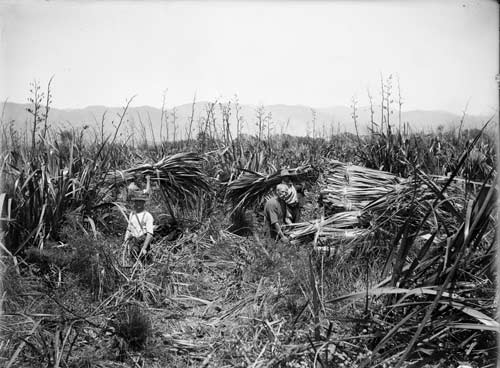 Now, the Manawatu region of New Zealand’s North Island [click here for map] is known for its farming and wind turbines, but for a few decades from the late 19th to early 20th centuries, flaxmilling was one of the region’s most important industries. When farmers began to drain the swampland to establish pasture in the late 19th century, they found the process stimulated the growth of the flax already growing naturally in the area. From this chance discovery, flaxmilling grew from the 1870s and continued until the 1930s. Continue reading
Share this:

“This sacrifice will bring retribution” – deforestation and its consequences
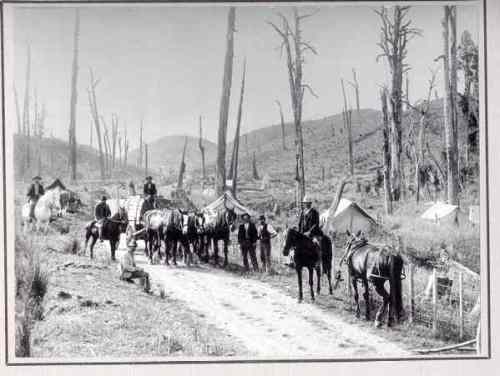 The following excerpts about deforestation in New Zealand are from the Evening Post, 29 March 1910. They are just as relevant today as they were 100 years ago.
“This sacrifice will bring retribution,” was a recent comment of The Times in relation to the shortsighted Australasian practice of “improving” forest land by wholesale destruction of the native woods. The process is so gradual that it does not impress as it should the resident who sees it year after year going on before his eyes; but there are those who can look back forty or fifty years and recall the aspect of wooded hills, vocal with the song of native birds, now waste and barren, scarred with landslips, not even affording pasture — an eyesore instead of a beauty… Continue reading
Share this:

Our favourite Californian – the history of Radiata Pine forestry in NZ
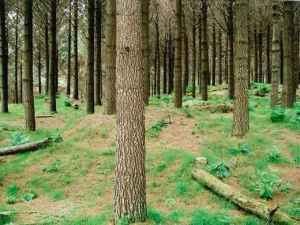 Radiata pine (Pinus radiata, known as Monterey pine in its place of origin, California), makes up nearly 90% of New Zealand’s plantation forest (1.6 million hectares). The pine grows much faster here than its homeland – about 7 times faster than in the US and 20 times faster than in Canada. No wonder then that New Zealand, along with Chile and Australia, are the top growers of this species worldwide. New Zealand also boasts the most extensive plantation forest, dominated by radiata pine, in the southern hemisphere (Kaingaroa Forest [click here for map]). So, how did this pine species become so integral to our landscape and economy? Continue reading
Share this:

The Canadian connection – Leon MacIntosh Ellis
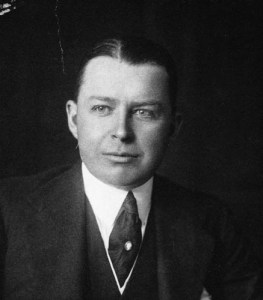 New Zealand’s State Forest Service and the forest management policies it implemented were shaped by its first director, Canadian Leon MacIntosh Ellis. Ellis was a strong proponent of plantation forestry and one of his most noticeable legacies, still very apparent today, is the extensive plantation forests of the central North Island.
Ellis was born on 17 July 1887 in Meaford, Ontario, Canada. He graduated with a BSc (Hons) in forestry from the University of Toronto in 1911. In 1919 he was interviewed for the Director of Forests position in New Zealand’s newly created Forestry Department, and arrived to take up the position the following year. Continue reading


