
When I lived in Japan, I took great pleasure from visiting Shinto shrines. Though I am not a religious person, there was something very spiritual and calming about these places. They were a place of solace and quietude. Shrines were sometimes only very small and simple affairs – often hidden in an unexpected corner of a bustling urban landscape. (Some are even found on the roofs of high-rise buildings!) But even in the case of these smaller shrines, it is rare that there is not a tree or two within the shrine gardens. But the larger shrines often have their own sacred groves (chinju no mori), and these groves only add to the calming “oasis” effect of a shrine. The Cryptomeria (sugi or Japanese cedar) tree is often prominent in such groves, as it is considered especially sacred within Shinto.
Such sacred groves are common in many Asian cultures but are not something I would naturally associate with New Zealand. Some would say (as I would) that they experience something like spiritual solace when walking in New Zealand’s indigenous forest. But of course this is not quite the same; this space has not deliberately set aside as a cultural artefact for a spiritual or religious purpose as a shrine has.
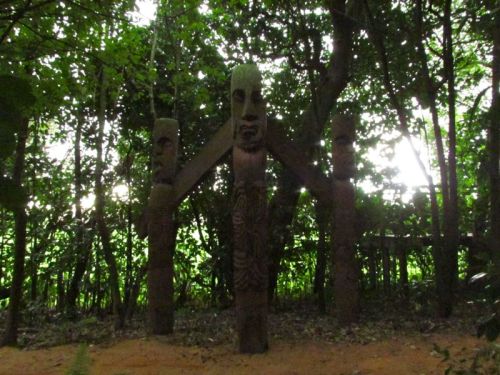
So it was with some surprise that I experienced a sense of the “sacred grove” a few weeks ago. The place is located in a research complex just outside of Palmerston North. Few would know of its existence, and even fewer would have visited it. I was alerted to its existence when researching the environmental history of the Manawatu for the book I am currently working on. The site is a karaka grove, which was once part of a much more extensive one located beside the Rangitane settlement of Mokomoko on the flats on the southern side of the Manawatu River. It was a deliberately planted “orchard”, one of a number that mark historic settlements of the Rangitane along the Manawatu River. The place can be regarded as particularly sacred, as it it is near the site where, in 1820, hundreds of lives were lost in a fierce battle between Rangitane and another tribe. The grove only survives because the first European settler who farmed there, J. O. Batchelor, recognised that it was special, and out of respect for Rangitane did not clear part of the grove. When the land was purchased for Massey Agricultural College, the little grove was fenced and preserved.
The carvings are in the traditional Rangitane style of stockade posts last used at the Puketotara pa in the 1800’s. The design is in the image of a pataka (food store) and part of the detail represents the taumatu atva stick used to secure rich harvests, symbols of life and growth. I felt privileged to experience this tranquil leafy oasis, and to understand more its history – and even happier that I was able to find it so near the place I grew up. I wonder how many more of such “sacred groves” there are to be “discovered”?

 envirohistory NZ
Reblogged this on envirohistory NZ and commented:
I thought I would reblog this post in light of my current research focus …
There are quite a few Karaka groves around the Whanganui/Manawatū area. In fact there’s a marae in South Taranaki/Whanganui called Pākaraka, the small rural community surrounding the marae has also taken Pākaraka as it’s name, it was called originally called Maxwell but now, people are deferring to it’s Māori name.
Pākaraka is the Māori name for a Karaka grove (lit. Karaka Village)
In Kai Iwi which is also close to the aforementioned Pākaraka (5-10km from each other) many Karaka trees are planted along the banks of the Kai Iwi stream, there is also a large amount of willow for some reason. Anyway, the Karaka drupes help to feed the eels in the stream (We also feed them left overs, some are quite large and will even come and eat out of your hand) the root systems of the Karaka trees also stabilise the banks of the streams, helping to combat erosion and helping utilise some of the excess nitrogen which has been seeping into the rivers and streams from dairy farms. High nitrogen levels in our rivers and cause algae to form, algae sucks the oxygen out of the water, the rivers our grandparents would swim in are sometimes unsuitable for us to swim in at times due to algal blooms which make the water toxic enough to kill a person or animals (Particularly our native fresh water fish which are already facing fierce competition from introduced species like trout, karp and catfish in areas, native fish species are going the way of the moa, our freshwater crustaceans like the fresh water crayfish, and freshwater mussels are unique but their populations are also failing in many areas)
Karaka trees are easy to grow, if you find a tree, you can often find small seedings growing underneath the tree which you can pick out and move to another area. The seedlings that grow about five to ten cms often won’t grow much more than that because the tree that they are growing under is blocking the sun and it’s deeper roots are able to obtain more water. By moving the small seedlings you’re increasing the chances that they’ll survive by 100%. Just plant them and leave them to grow, they are very low maintenance. With the Karaka drupes, be careful because dogs may eat them, while the flesh isn’t poisonous, the pits/kernels are highly toxic. When Māori ate the Kernels they would have to cooked for hours and hours in order to make them edible.
Sorry, looks like I got a little carried away and i can be quite pedantic when it comes to sharing knowledge, doing my very best to ensure that I’m sharing information correct.
If you have any questions at all please do not hesitate to contact me on cmcneill634@gmail.com
(Just randomly thought I’d share that I’m going to try and bonsai a Karaka tree, apparently it’s been done before so here’s hoping I have some luck. I’ve never tried to have Karaka as an indoor plant so it should be an interesting project)