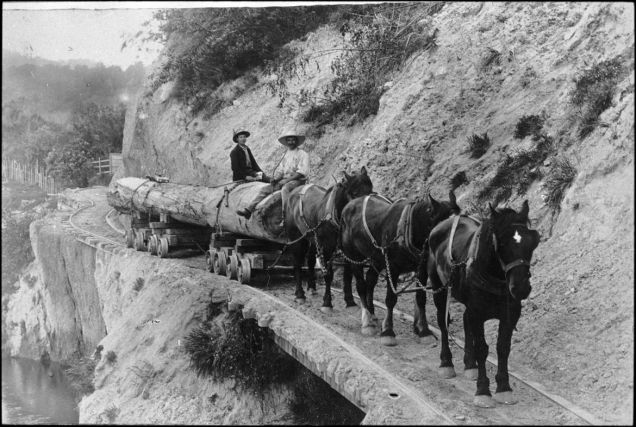
Hauling logs across Te Awaoteatua Stream: Wildbore cache no. 3

Hauling log Te Awaoteatua Stream.jpg
Horses pulling a milled log across the Te Awaoteatua Stream bridge at the bottom of Church Hill, Awahou. The man sitting on the front of the log is Mat Mai, Wildbore’s brother-in-law. The brakeman at the back is Trevor Madson. Date unknown. Palmerston North Library.

The third cache in the Wildbore geocache series is hidden near the site of this photograph, taken by Charles E. Wildbore, showing two Valley men  pulling a milled log across the Te Awaoteatua Stream bridge at the bottom of Church Hill, Awahou.

The road down to the stream was realigned in the late 1960s/early 1970s, but it can still be seen in the face of the hill when looking north from the bridge (it is also visible as a contour in Google maps). Continue reading

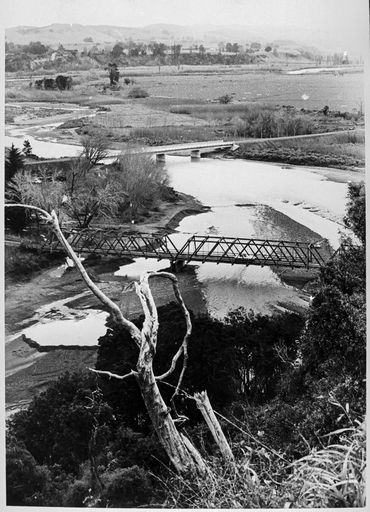
“Ghost bridge” – Wildbore cache no. 2

Old and new Raumai Bridge 1973.jpg
The old and new Raumai Bridges in 1973, before the old bridge was demolished. This view is looking north-west from No.4 Line. Palmerston North Library courtesy Manawatu Evening Standard

Those who have travelled up the eastern side of Pohangina Valley, to visit Totara Reserve, for example, will have crossed the Raumai Bridge. Those with more life experience may also the old Raumai Bridge, a bridge with a troubled past. Continue reading

The school that moved: Wildbore geocache no. 1

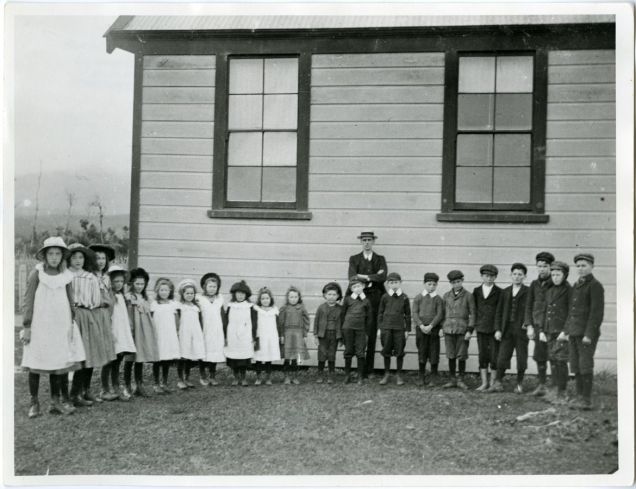
Awahou South School 1909
Teacher and pupils at Awahou South School, No. 4 Line, 1909. Palmerston North Library. Left to right: Norah Callesen, Annie Millen, Eileen Lynch, Kate Henson, Agnes Spelman, Kathleen (Gay) Spelman, Adelia (Delia) Spelman, Olive Hunt, Mary Leamy, Eileen Spelman, Mary Wellock, Albery Henson, Oscar (Tui) Callesen, Bernard Spelman, Unknown (Delph Spelman?), Tom Leamy, Cliff Spelman, Unknown x2, Henry Hunt. Teacher: Mr Lewis.

In 1977, an entire school house moved from its existing location on a country road in the shadow of the Ruahine Range in the Manawatu to the main street of Palmerston North City, nearly 30 kilometres away. To be fair, it was just a one-room school house, one of just over 40 square metres. The school was built in 1902, to take pupils within a 10-mile radius, who travelled to school by foot or pony. When it opened, it had a roll of 20, and by 1907, the number had increased to 32. Continue reading

New book explores NZ’s environmental history through photographs

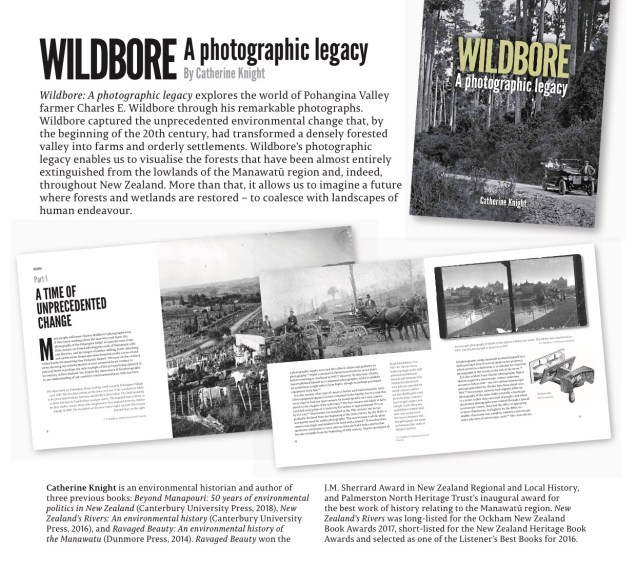
Want to know more about WILDBORE: A photographic legacy, or pre-order a copy? Download an Information flyer.

Wildbore Info Sheet.jpg

Reading the landscape via photographs of the past

In a post last week I talked about my next book project, a book entitled WILDBORE: A photographic legacy, showcasing the photographs of pioneering farmer and bee-keeper of the Pohangina Valley.

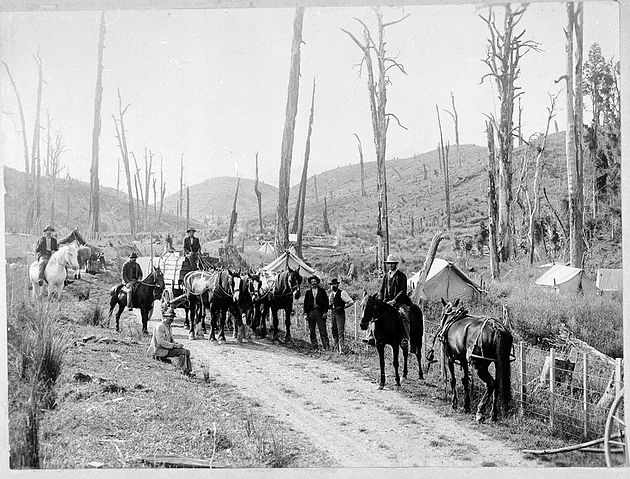
One of Charles E. Wildbore’s most evocative images (in a desolate kind of way) is this one of men getting ready to cart sleepers from Crown-owned reserve land in Pohangina Valley to the nearby railway station at Ashhurst. This road borders what is today known as Totara Reserve (originally set aside by the government for its timber), and is in fact not far from where I live. The other day, I drove up to the road in an effort to find the exact place he took the photograph – and was excited to locate it with relative ease. Well almost – judging from the terrain, the alignment of the road today is just to the south of its original route, on slightly higher ground.

Opawe Road 1904 Continue reading

‘A vision to restore the environment’: how history helps us make sense of the present

OLYMPUS DIGITAL CAMERA
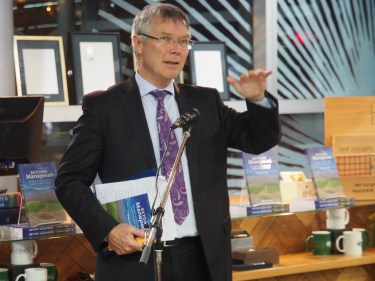
Minister for the Environment, David Parker, speaking about his passion – the environment – at last month’s launch of “Beyond Manapouri”

Earlier this month, the Minister for the Environment David Parker made an address to the Forest & Bird annual conference entitled “A vision to restore the environment”. I was delighted to see he made reference to my book Beyond Manapouri, and how history helps us put events today into context.  Here is an excerpt of his speech, which can be read in full on the Beehive website:

Last week I had the privilege of speaking at the launch of Catherine Knight’s new book Beyond Manapouri – 50 years of environmental politics in New Zealand. Continue reading

Exploring our environmental history though the remarkable photos of Wildbore

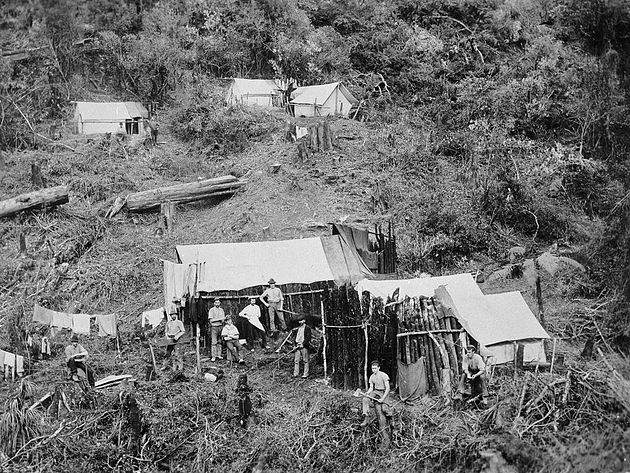
Bush-whacker camp

Now that ‘Beyond Manapouri’ is safely out into the world, some of you may have been wondering what my next book project is.

Well, since you asked ;-), it is a book exploring the life and works of a man called Charles E. Wildbore, who emigrated to New Zealand as a boy in 1874, and settled in the newly-opened Pohangina Valley, in the Manawatu. Wildbore was unremarkable in many ways. Like many other settlers of this era, he and his wife Jane owned a small farm, with a small herd of dairy cows, and some chickens. He also had an apiary and produced honey for the local market.

But what does make Wildbore remarkable are his photographs. Continue reading

Launch of “Beyond Manapouri” – photos!

We couldn’t have hoped for a more successful launch of Beyond Manapouri: 50 years of environmental politics in New Zealand last week at Vic Books, Wellington. Thank you to all who came along – many from far afield. Minister for the Environment David Parker gave a cracker of a speech, with a few laughs in there as well (as evidenced by the photographs!). Photos by Dave Kelly.

This slideshow requires JavaScript.

Will we ever see another “Manapouri”?

Lake Manapouri NZ Herald

Has New Zealand failed its environment? is the question asked by Jamie Morton, Science Reporter at the New Zealand Herald, in his piece published yesterday about Beyond Manapouri: 50 years of environmental politics in New Zealand (Canterbury University Press) [read article here].

In his interview, one of the questions Jamie asked me was:

‘Looking into the near future, what do you think will be the big issues of contention? Is there anything on the horizon that might prove New Zealand’s next Manapouri?’ Continue reading