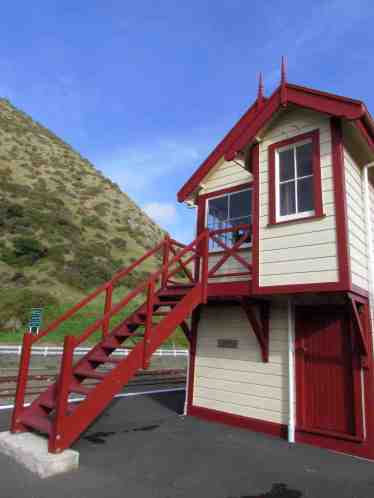
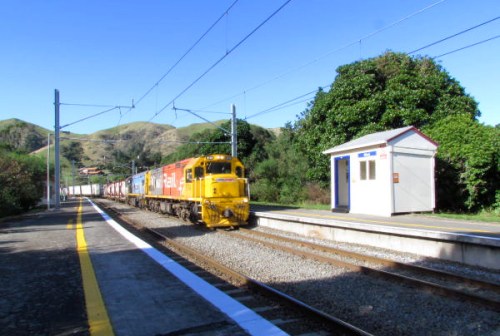
 This signal box on the Paekakariki Railway Station platform tells of an illustrious history of a small coastal town intimately linked with the railway. The railway station dates from 1886 when the Wellington and Manawatu Railway Company’s line from Wellington to Longburn was completed. The railway runs alongside the state highway, the Paekakariki to Porirua segment of which was completed nearly four decades before, in 1849. Both transport links run through a narrow corridor of flat land wedged between steep hills to the east and the sea and old dune-lands to the west [click here to view map]. The town itself lies on a narrow band of undulating dune-lands, contributing to its slightly idiosyncratic character; its name, meaning “perch of the kakariki parrot” in Maori, seems particularly apt. Continue reading
commentary

The end of whaling in New Zealand: the Soviet factor
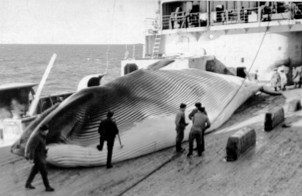 Like so many other industries based on a finite natural resource, whaling in New Zealand has a long history of over-use, leading to a collapse of that resource. The southern right whale was caught from shore-based stations in the early nineteenth century, but by 1850 their numbers had been so depleted that shore-based whaling was limited. Continue reading
Share this:

Black gold – early oil exploration in Taranaki
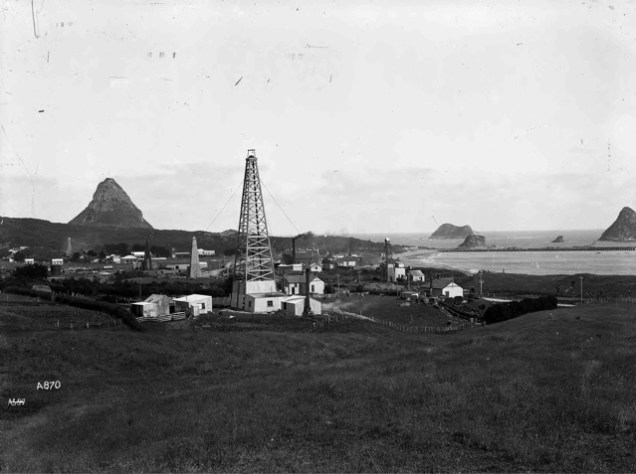 Oil exploration in Taranaki has been in the news lately, with Greymouth Petroleum and international companies expressing strong interest in the oil reserves under Taranaki soils and sea-bed. Until recently I had assumed that oil exploration was a phenomenon of the 20th century – until a Taranaki resident informed me that it was being extracted around New Plymouth as early as the 1800s. Continue reading
Share this:

Forests: why they are vital to our environment and economy
Tomorrow (June 5) is World Environment Day, and this year’s theme is Forests. This short animated film, narrated by David Attenborough, explains the role forests play in our global economy and environment, as well as outlining the threats our forests face.
See also: Destruction of our forests over time.
Share this:

Opiki toll bridge: graceful relic of a thriving flax industry
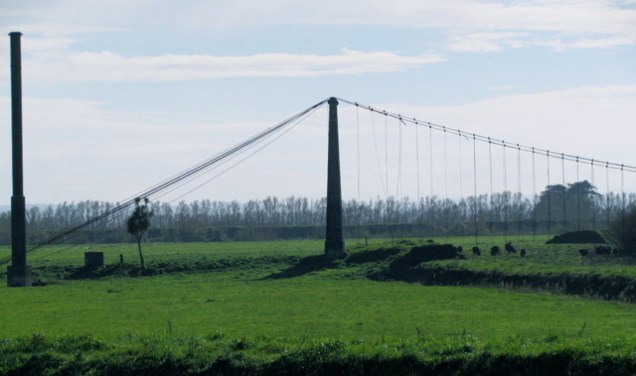 When driving north along State Highway 56 through the low-lying plains flanking the Manawatu River, a traveller cannot help but notice a suspension bridge to the north of the current road, a tall industrial chimney incongruously positioned at the western end of its span [click here to view map]. Now, its suspension wires dangle without purpose, as if suspended in time as well as space, but this graceful structure still strikes a dignified – if somewhat ghostly profile – on the landscape, hinting at an important role it played in the local economy in the not too distant past. Continue reading
Share this:

Revenge of the jungle – Ta Prohm, Cambodia
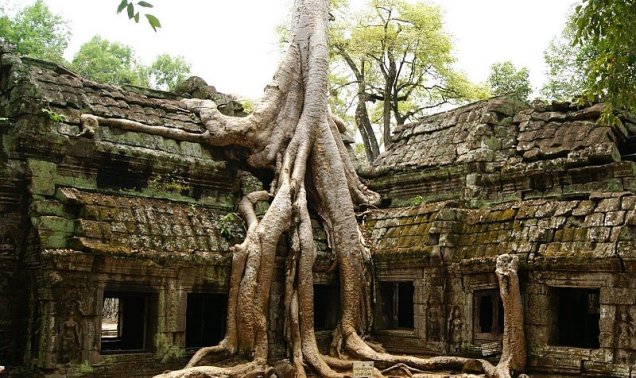 This photo, taken by a colleague on his recent travels through Cambodia, represents environmental history at its most palpable: it shows the perpetual tension between nature and human society – this being a rare occasion where nature has demonstrably won the battle. Continue reading
Share this:

Earthquake reveals the forgotten streams of Christchurch
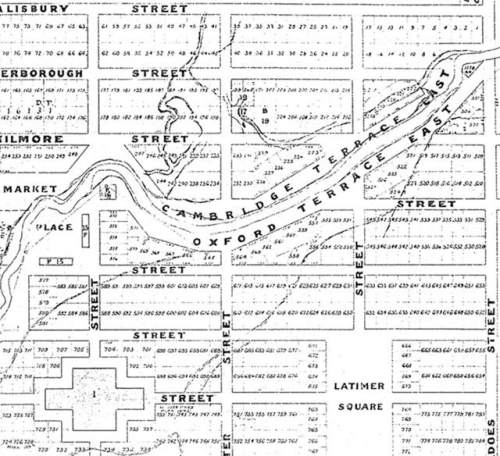
As explored in the earlier post Christchurch – a city haunted by its environmental past, Christchurch’s environmental history had serious – arguably fatal – implications in the February earthquake. As the post discussed, this related especially to the fact that much of what is now a city was once a vast swamp, comprised not only of the two rivers that still run through the city (the Avon and Heathcote), but also numerous other streams that fed an extensive wetland system. Continue reading
Share this:

The city of hidden lagoons: Palmerston (of the north)
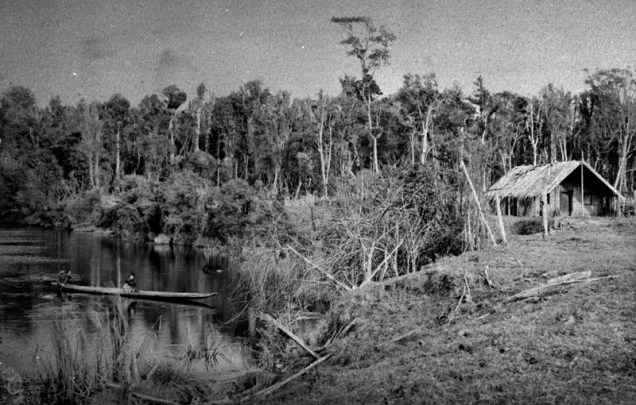 I came across this photo on the Manawatu Memory Online site the other day, while looking for an image of early Manawatu history. I was immediately captivated by the image. It is the 1881 photograph of the now long-gone Awapuni Lagoon, located in what is now the south-western corner of Palmerston North city, about where the Awapuni racecourse is today [click here to view map]. Continue reading
Share this:

Scandinavians, earthquakes & whales: top 5 posts of first quarter of 2011
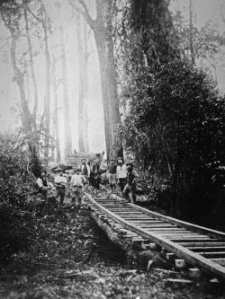 At envirohistory NZ, we like to review the most popular posts of each quarter (though sometimes – such as on this occasion – a little late). The top five posts of the first quarter of 2011 covered a wide breadth of topics, from the the environmental histories which contributed to the devastating consequences of the seismic disasters of Christchurch and Japan; an urban wetland; a history of whaling in New Zealand; and the Scandanavian settlers of the Manawatu. Here are the topics in order of hits:
1. The Scandinavian settlers of the Manawatu
2. Waitangi Park – an urban wetland recreated
3. Christchurch: a city haunted by its environmental past? Continue reading
Share this:

Last train to Muri: train station closes after 60 years
 Having a train-mad two year old means that I get to ride trains a lot. This is fine by me, because trains are a great vantage point from which to gain insights into our environmental history. They bring us closer to how our forefathers saw the world before cars were the main means of transport. Continue reading

 envirohistory NZ