This week I spoke to RNZ’s Jesse Mulligan about the conversation our political leaders aren’t having. The fact that we live on a finite planet, and we cannot sustain an economy that is dependent on exponential growth (whether we label it “green” or not).
Instead, we should be talking about the alternative, and only viable future pathway: an economy centred on wellbeing, which operates within safe ecological limits. Listen to our conversation here.
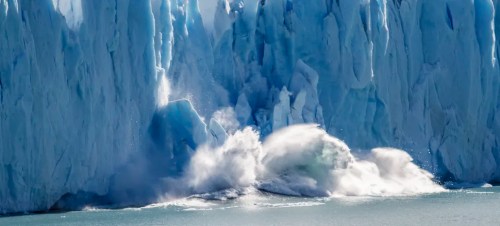
‘Collapse’ – the complete breakdown of society as we know it. Photo: Newsroom
Is there anything more terrifying than the prospect of global collapse in the near future? Yes, undoubtedly: the possibility that collapse is already happening but we just don’t realise it.
‘Collapse’ used as a simple unmodified noun refers to the complete breakdown of society as we know it. It may be precipitated by climate change, but it could also be triggered by any number of other crises, including another, even more brutal pandemic than Covid-19, a global financial crash or sudden energy disruption. Or a combination of some or all of these.
The cause is almost academic, because all of these things are related. They are all symptoms of a single problem, which is that humans (and especially high-income nations) are overshooting the planet’s ability to regenerate and self-regulate, fuelled by the one-off bonanza of fossil fuels, which have allowed us to produce and consume more (and pollute more) than any other time in history.
I originally pitched this short opinion piece to Stuff to follow on from an earlier piece on degrowth. However, when I submitted the finished piece, the editor declined to publish, stating that ‘it was too like other pieces published lately’ and that the audience had reached saturation point on green growth and degrowth issues. (A deeply ironic statement given that almost everything published in mainstream media is supportive and unquestioning of a growth-oriented narrative.) I also felt it would be prescient given the upcoming debate on degrowth versus green growth hosted by University of Victoria.
In light of Stuff publishing this opinion piece in response to the debate, in which the author seems to be calculatedly stirring up Red Menace anxieties reminiscent of the Cold War era by selectively cherry-picking the likes of Marxist scholar Kohei Saito’s writings as if representative of degrowth scholarship, I thought I needed to get my original piece out there one way or another.
As I have argued previously, for the future of our country and our planet, we urgently need a mature and evidence-based discussion. This kind of fear-mongering (degrowth is a thinly-veiled Marxist plot and without growth we will no longer have cancer drugs or dialysis machines) and sneering academic elitism (‘degrowth is intellectually chaotic’ – not to mention one of its main advocates is an anthropologist who believes he has expertise on the economy!?) certainly fulfils mainstream media’s desperation for click-baity headlines, but does nothing to progress a reasoned, open-minded debate on arguably the most important issue of our time.
As I have argued elsewhere, every New Zealander has a right to have a say on the future of our economy and our planet – this should not be be the preserve of economists institutionalised within government or academia. So here is the piece that Stuff refused to publish.
A growing number of New Zealanders are expressing deep concern about climate change, particularly as recent extreme weather events on our shores show that this is no longer a remote issue that only affects people in other countries. It is affecting us here, now: destroying homes and livelihoods, disrupting communities, causing heartbreak and distress, and in the most tragic cases, loss of life.
But despite our growing concern, many of us remain quietly optimistic about the future – reassured by daily offerings from mainstream media filled with stories of innovators developing new technology that will instantly create clean energy, suck up carbon dioxide by the truck-load, and turn waste into energy or other useful things like car-seat covers. The message is, we can carry on living the energy- and resource-intensive lives we do now because clever scientists, innovators and tech geniuses will find a way out of this.
Green growth adds to the bright shiny promise that we can keep on living the way we do now (using resources at a rate equivalent to one and three-quarter Earths). Green growth promises that we can carry on pursuing growth (after all, if we don’t have growth, how will we pay to fix all the damage we are causing?) – all we need to do is decouple it from greenhouse gas emissions and other environmental harm. This can be done, green growth advocates tell us, by increasing productivity and efficiency, moving to a more circular economy, and reducing waste. All without making a dent in growth!
Through the Intergovernmental Panel on Climate Change (IPCC), climate scientists have delivered their final warning: we need to take bold action urgently to avert the untold environmental and human tragedy of irreversible climate breakdown. So, if the promise of green growth (or its affable cousin, ‘sustainable growth’) hasn’t been realised yet and there is no evidence that it will at the rate and scale required, isn’t it time we gave up on that idea and moved on to something that does give us – and more importantly, our children and their children – a chance?
That ‘something’ is degrowth. If that sounds a bit subversive, steady-state economy, doughnut economics or wellbeing economy are other economic models that embrace the same foundational principle: that is, an economic system that puts human wellbeing and ecological balance at the centre, not the blind pursuit of growth.
As discussed in this earlier piece published on Stuff, degrowth does not advocate for the carte blanche downscaling of the economy as a whole – rather it argues for the upscaling of the parts of the economy that will enhance human wellbeing while reducing our impact on the planet. These sectors include renewable energy generation, public transport, education and health and care sectors, sustainable food production, energy-efficient homes and repairable long-lasting goods. At the same time, it argues for the downscaling of the parts of our economy that are damaging to the environment, with little or no benefit for our collective wellbeing – such as single-use products and designed-in obsolescence, private vehicles, air travel, fast fashion and industrialised meat and dairy production.
And it is important to remember too, that while perpetual, compounding growth, as measured by GDP, has become the central goal for which all ‘modern’ economies strive, it has only been so since the 1950s. Since then we have become entranced by it glittering promises of ever-growing wealth for all; simultaneously blinded to all the damage that our ever-expanding global economy is doing to our planet’s seas, forests, freshwaters, atmosphere and – ultimately – to our descendants’ chances of being able to lead flourishing, fulfilling lives.
Isn’t it time we found another guiding star for our economy – that of wellbeing for all, including the living things we share this planet with?
Here is my second recent article, published on Newsroom. It argues that if we believe the cost of living crisis is more than a momentary blip, we need policy that will strengthen NZ’s own food security and encourage bioregionalism.
New Zealanders have been finding their supermarket shop a painful experience for some time now, but in December many reached their pain threshold as food prices increased by 10.6 percent compared with 2021. Fresh produce was a whopping 24 percent more expensive – at a time of the year when it is usually plentiful and cheap. Economists reassure us this is just a momentary blip in an otherwise smoothly running economic system – prices will ‘soften’, inflation will ‘moderate’ and ‘better times will come’. These reassurances are comforting and most of us are happy to be soothed by this narrative.
But what if empty supermarket shelves and high prices are symptomatic of something much bigger? A sign of a broken system, now starting to show the tell-tale fissures of climate disruption, ecological collapse, energy descent and increased resource scarcity.
The immediate causes of surging food prices are familiar to most of us: high shipping costs, supply chain disruption, a tight labour market, disrupted weather patterns, spiralling on-farm costs such as fertiliser and diesel.
But all these factors are more connected than we might think.
I have made a bleak realisation. I am a failure. I have failed at the single most important role in my life – to safeguard the future for my children.
This has been an awful realisation to make, and it crystallised when my 14-year old son, after listening to some climate-related report on the radio said, ‘We are doomed, aren’t we, Mum?’. Unusually for him, there was not even a hint of facetiousness or irony – he was quite sincere.
At that moment, a bit of my heart shattered into pieces.
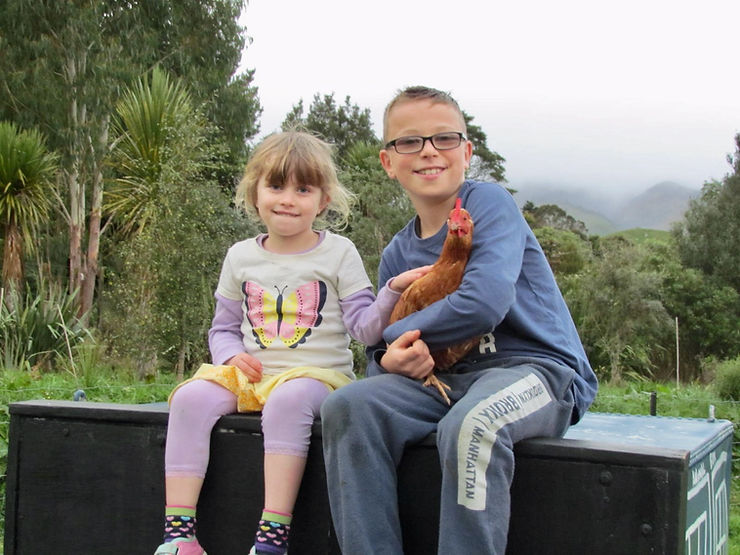
Carter and Caitlyn with Rosie the chicken. What will their future hold?
We now face the growing certainty that we will breach the 1.5 degree warming threshold that may have enabled us to avoid catastrophic and irreversible climate change. We have been warned that accelerating climate breakdown will lead to more severe and frequent climate disasters, ecological collapse, economic and social breakdown and unimaginable human suffering, including starvation, illness, displacement and death.
Or as UN Secretary-General Antonio Guterres so starkly put is a few days ago, ‘we are on a highway to climate hell’ with the option to cooperate or, enter a collective suicide pact, and perish.
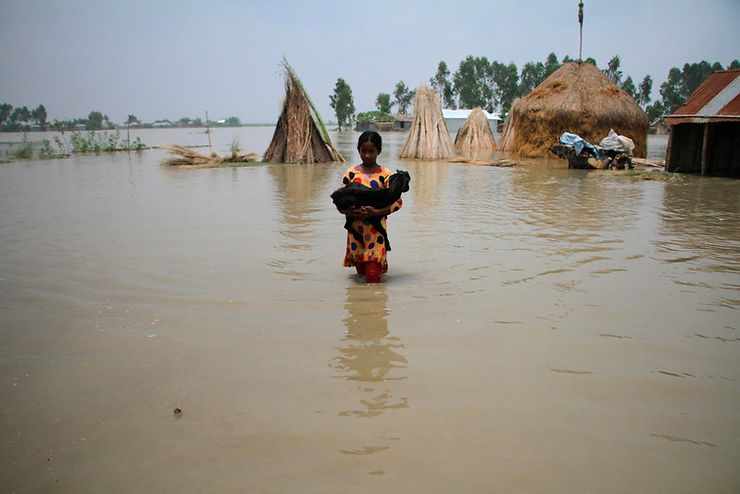
A girl carries a goat through floodwaters in Bangladesh. Climate Outreach.
Even if my children do not experience the worst of this ‘climate hell’ first-hand, they will see it unfold in parts of the world, including the ‘global south’, most vulnerable to climate disruption.
Carter playing his beloved uke, Pippa by his side, under the macadamia nut tree.
As parents, we have worked to equip our children with the skills and attributes they will need when their time comes to navigate the adult world, and hopefully help make it a better place: critical thinking skills, a basic understanding of democratic process, compassion and empathy, and self-belief, especially when they hold views different from others.
And as a parent, I can only hope that this will be enough to weather the climate storm ahead.








 envirohistory NZ