Election 2023: Big on marketing, short on vision

Image courtesy the Kaka.

In this piece for the Kākā, I argue that this election is big on marketing strategy and slogans, but appreciably thin on vision. And it is a marketing campaign largely based on the assumption that the voter is Homo Economicus – that is, a person who makes decisions exclusively guided by self-interest. But my sense is that, despite what politicians think, New Zealanders do care about the world beyond their own economic status – and a growing number of us are acutely aware that the growth-based economy is not working for either people or the planet. But New Zealanders are not being given the chance to contemplate an alternative future because no one in any position of influence is talking about it. Our politicians are too pre-occupied with their desperate appeals to Homo Economicus.

Read the full article on the Kākā.

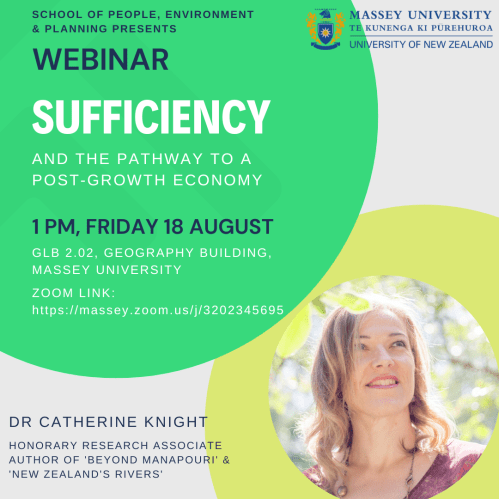
Sufficiency and the pathway to a post-growth economy – recording available

In August I presented a seminar, hosted by Massey University, on what I believe to be the single most important issue we face today. That is, how to reconcile our growth-based economy and energy-intensive way of life with the polycrisis that means a liveable planet hangs in the balance.

In the talk, I argue that we simply cannot reconcile these two things – contrary to what we are led to believe by the proponents of green growth. Instead, we must let go of growth as the central goal of our economy and focus instead on what a society needs to deliver to achieve wellbeing for all, within the limits of a finite planet.

I argue that a key policy goal must be “sufficiency” – with the right vision, it is an idea that people from across the political spectrum are likely to coalesce around, unlocking the pathway to a better future.

For those who missed the seminar, here is a link to the recording (passcode: 0U3PW@sA).

A post-growth future: the pathway away from environmental collapse

Many of us are aware by now that we are facing multiple crises: climate change being just one – warming and acidifying oceans, depleted soils, global habitat and biodiversity loss are among the others in this ‘polycrisis’. The Auckland floods have made us acutely aware of how vulnerable our cities are to the ravages of extreme weather, events predicted to become more extreme and frequent as the effects of climate change bed in.

We know that this is not going to get better any time soon. There will be more floods, droughts and other weather events that will cause destruction, economic loss and human distress on a scale that we cannot yet imagine. Even the issues that affect us day to day, such as the cost of living, have at their root the unsustainability of our current economic system.

The realisation is dawning among many of us that we cannot solve this problem following the same path that led us here – that is, an extractive growth-oriented economy dislocated from the realities of a finite planet.

Read the article on Newsroom.