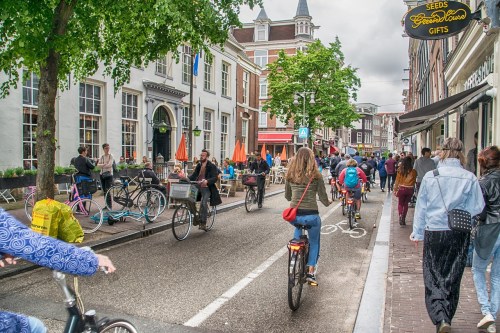
A people-centred street-scape in Amsterdam. Pixabay
I was recently invited to write an editorial for City Changers, a European-based organisation helping to create better cities and towns for the future. This followed a LinkedIn post I wrote earlier this year critiquing the promotion of EVs as a solution to climate mitigation – the post went, as they say, viral.
In my City Changers article I expand on this original critique but focus more on the actual solution: cities, towns and rural communities built for people not heavy, energy-guzzling metal boxes.
Here is an excerpt:
To address the emissions and high energy and resource demands of our transport system we must change the system: move away from car-centric towns and cities by investing properly in public transport and make active transport (walking, wheelchair use, and cycling) safe and enjoyable. There will also be a role for on-demand and shared vehicle mobility, which yes, will likely be electric – but our goal should not (and cannot) be the replacement of the entire ICE fleet with EVs.
But most importantly, we must shift the conversation. Rather than focusing on how to get people and stuff from A to B, we should be talking about how we can build future cities and towns that will meet people’s needs for ‘a good life’ within a 15 minute or so walk, cycle, or quick and easy public transport ride of people’s homes.
Leaf blowers made from recycled materials or designed to last for 10 years are still products that no one actually needs, produced using scarce energy and resources, with the sole purpose of making a profit. Newsroom
In this piece on Newsroom, I argue that just as the architects of our current economic system designed the system around perpetual growth, we can redesign the economy around delivering wellbeing to all, within planetary limits
“Every civilisation has had its irrational but reassuring myth. Previous civilisations have used their culture to sing about it and tell stories about it. Ours has used its mathematics to prove it.”
The economist and writer David Fleming was speaking about our civilisation’s myth of perpetual economic growth. And the mathematics, along with the graphs, models and analyses supporting this myth have become increasingly elaborate – inscrutable to the average person, who dares not question their truth. But now, it is not just mathematics used to assert the validity of a growth-based economy, we have added words to our arsenal of myth-making.
I originally pitched this short opinion piece to Stuff to follow on from an earlier piece on degrowth. However, when I submitted the finished piece, the editor declined to publish, stating that ‘it was too like other pieces published lately’ and that the audience had reached saturation point on green growth and degrowth issues. (A deeply ironic statement given that almost everything published in mainstream media is supportive and unquestioning of a growth-oriented narrative.) I also felt it would be prescient given the upcoming debate on degrowth versus green growth hosted by University of Victoria.
In light of Stuff publishing this opinion piece in response to the debate, in which the author seems to be calculatedly stirring up Red Menace anxieties reminiscent of the Cold War era by selectively cherry-picking the likes of Marxist scholar Kohei Saito’s writings as if representative of degrowth scholarship, I thought I needed to get my original piece out there one way or another.
As I have argued previously, for the future of our country and our planet, we urgently need a mature and evidence-based discussion. This kind of fear-mongering (degrowth is a thinly-veiled Marxist plot and without growth we will no longer have cancer drugs or dialysis machines) and sneering academic elitism (‘degrowth is intellectually chaotic’ – not to mention one of its main advocates is an anthropologist who believes he has expertise on the economy!?) certainly fulfils mainstream media’s desperation for click-baity headlines, but does nothing to progress a reasoned, open-minded debate on arguably the most important issue of our time.
As I have argued elsewhere, every New Zealander has a right to have a say on the future of our economy and our planet – this should not be be the preserve of economists institutionalised within government or academia. So here is the piece that Stuff refused to publish.
A growing number of New Zealanders are expressing deep concern about climate change, particularly as recent extreme weather events on our shores show that this is no longer a remote issue that only affects people in other countries. It is affecting us here, now: destroying homes and livelihoods, disrupting communities, causing heartbreak and distress, and in the most tragic cases, loss of life.
But despite our growing concern, many of us remain quietly optimistic about the future – reassured by daily offerings from mainstream media filled with stories of innovators developing new technology that will instantly create clean energy, suck up carbon dioxide by the truck-load, and turn waste into energy or other useful things like car-seat covers. The message is, we can carry on living the energy- and resource-intensive lives we do now because clever scientists, innovators and tech geniuses will find a way out of this.
Green growth adds to the bright shiny promise that we can keep on living the way we do now (using resources at a rate equivalent to one and three-quarter Earths). Green growth promises that we can carry on pursuing growth (after all, if we don’t have growth, how will we pay to fix all the damage we are causing?) – all we need to do is decouple it from greenhouse gas emissions and other environmental harm. This can be done, green growth advocates tell us, by increasing productivity and efficiency, moving to a more circular economy, and reducing waste. All without making a dent in growth!
Through the Intergovernmental Panel on Climate Change (IPCC), climate scientists have delivered their final warning: we need to take bold action urgently to avert the untold environmental and human tragedy of irreversible climate breakdown. So, if the promise of green growth (or its affable cousin, ‘sustainable growth’) hasn’t been realised yet and there is no evidence that it will at the rate and scale required, isn’t it time we gave up on that idea and moved on to something that does give us – and more importantly, our children and their children – a chance?
That ‘something’ is degrowth. If that sounds a bit subversive, steady-state economy, doughnut economics or wellbeing economy are other economic models that embrace the same foundational principle: that is, an economic system that puts human wellbeing and ecological balance at the centre, not the blind pursuit of growth.
As discussed in this earlier piece published on Stuff, degrowth does not advocate for the carte blanche downscaling of the economy as a whole – rather it argues for the upscaling of the parts of the economy that will enhance human wellbeing while reducing our impact on the planet. These sectors include renewable energy generation, public transport, education and health and care sectors, sustainable food production, energy-efficient homes and repairable long-lasting goods. At the same time, it argues for the downscaling of the parts of our economy that are damaging to the environment, with little or no benefit for our collective wellbeing – such as single-use products and designed-in obsolescence, private vehicles, air travel, fast fashion and industrialised meat and dairy production.
And it is important to remember too, that while perpetual, compounding growth, as measured by GDP, has become the central goal for which all ‘modern’ economies strive, it has only been so since the 1950s. Since then we have become entranced by it glittering promises of ever-growing wealth for all; simultaneously blinded to all the damage that our ever-expanding global economy is doing to our planet’s seas, forests, freshwaters, atmosphere and – ultimately – to our descendants’ chances of being able to lead flourishing, fulfilling lives.
Isn’t it time we found another guiding star for our economy – that of wellbeing for all, including the living things we share this planet with?
It is rare these days to hear anyone say, ‘We want more growth, and if that means destroying the environment, well, that’s the price we must pay!’ Local and central government documents are adorned with such statements as ‘We are going to grow our city/district/economy, while protecting and enhancing the environment, and transitioning to a low-carbon future’. Most of us would relate more to the second kind of statement – it sounds more, well, sustainable.
But which one is more honest?
In an attempt to answer this, I have been exploring the literature around green growth. This is the idea that we can continue growing the global (and national) economy, while reducing our impact on the environment, and especially climate. The central assumption is that we can decouple economic growth from greenhouse gas emissions and resource use.
So, how is this going? Not that well so far. As of 2022, seven years after the Paris Agreement agreed to maintain global temperatures below 1.5 degrees, global CO2 emissions are still rising.
That may be so, but haven’t some countries managed to decouple their economies from emissions? Yes, one study often cited to support the case for green growth found that between 2005 and 2015, 18 countries (mainly – but not all – European) have decreased their CO2 emissions by 2.4% per year collectively – though that decrease can in part be explained by a slowdown in GDP growth rates.
And, while decoupling of emissions is happening in some regions, there are almost no cases of the absolute decoupling of resource use (i.e., a decrease in resource use while GDP continues to go up).
And of course, it is important to remember that the biosphere doesn’t care where emissions come from. So if one country is able to decouple its emissions by – at least in part – outsourcing polluting industries to another country, that’s good for its emissions footprint but doesn’t make a jot of difference for the health of our planet.
But can’t we just plant more trees, to suck up our growing emissions and reach ‘net zero’ that way? Not according to Climate Commissioner Dr Rod Carr, who says this only reinforces a ‘plant and pollute’ mindset. Carbon sequestration through tree-planting is riddled with problems, including the time it takes for a newly planted forest to mature and sequester at an optimal rate (when emissions and harm from emissions is happening now), and the fact that once it reaches maturity, sequestration plateaus. To use forests to sequester our growing emissions, we would also need an immense amount of space, inevitably compromising capacity for food production. Impermanence is another major flaw – forests are vulnerable to multiple risks, including fire, disease, destruction for other land uses, and of course harvesting for timber. In a (tree)nut-shell – trees are great, but they shouldn’t be our strategy to reduce carbon in the atmosphere.
But what about negative emissions technology, such as BECCS (bioenergy and carbon capture and storage)? This is what many (including the IPCC) are pinning their hopes on. Scaling BECCS to the level required to meet net zero targets will require a vast area of agricultural land (estimated to be equivalent to two times the size of India – for best results the size of Africa would be even better) and colossal quantities of water and fertiliser to grow the crops required to create biofuels (recent estimates put both at double current global usage), shooting through already strained biophysical limits, not to mention being problematic for global inequities (which countries are going to forgo food-making capacity to enable us to continue our pursuit of growth?). Check out this video explainer on BECCS.
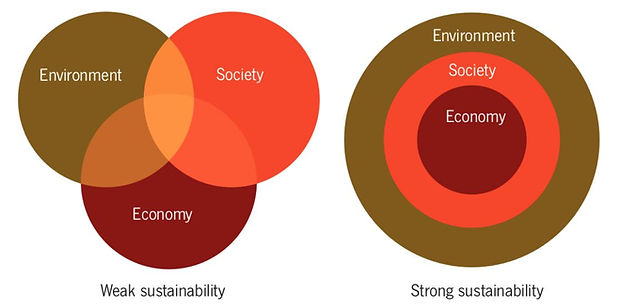
Broadening the discussion for a moment to the idea of ‘sustainable development’, established as a foundational principle at the 1992 Earth Summit at Rio de Janeiro, including being enshrined in our own Local Government Act 2002, has also been criticised as a vague and contradictory concept enabling governments to promote the message that ‘we can have it all at the same time, i.e. economic growth, prospering societies and a healthy environment. … This so-called weak version of sustainability is popular among governments, and businesses, but profoundly wrong and not even weak [sustainability], as there is no alternative to preserving the earth’s ecological integrity.” (Klaus Bosselmann in his book ‘The principal of sustainability’ (2017)). Our difficulty in decoupling environmental harm from economic development certainly supports this critique.
And from a New Zealand perspective, numerous environmental indicators tell us that since the enactment of the Resource Management Act in 1991, based on the principle of ‘sustainable management’, degradation of our environment has only accelerated. (For a more in-depth discussion of this, see Beyond Manapouri: 50 years of environmental politics in New Zealand.)
So where does this leave us? While the idea that we can continue to pursue growth while reducing harm on the planet (through reduced emissions and resource use, environmental destruction and degradation) may remain alive in theory, there is little empirical evidence that it is possible in practice. Put simply, it hasn’t happened so far.
So at what stage do we abandon the imperative for growth and focus instead on the pursuit of human and planetary wellbeing?





 envirohistory NZ