The darker side of Liberalism

Further musings on Lord Palmerston, the Great Irish Famine and the future of society
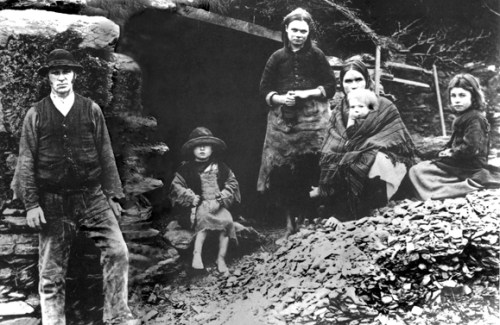
A family during the Great Famine

In my last post I talked about the man behind the name of not one but two urban centres in New Zealand, Henry John Temple, better known by ‘noble’ title, Lord Palmerston. I wrote about his inhumane treatment of impoverished and starving Irish tenant farmers on his bounteous estates in Sligo, north-eastern Ireland. His main focus was ridding himself of this wearisome burden, so he (literally) shipped them off to North America. Many died agonising deaths from malnutrition and illness on the way, or once they got to their destination.

In this post I am keen to explore another aspect of this history – a political ideology that has had tremendous influence on our political economy and our lives today. That is, Liberalism. (Noting that its derivative ‘Libertarianism’ is related but distinct in some critical ways but will not delve into this here.)

Because, as well as being a wealthy landlord with questionable morals, and the namesake of several places in ‘the colonies’, our man Lord Palmerston was also the first Liberal Prime Minister. The Liberal Party was first formed in 1859 when the Whig party – the main rival to the more conservative Tories – merged with a couple of other parties with equally radical ideas.

So what is Liberalism? The Concise Oxford Dictionary of Politics tells us that generally speaking it is ‘the belief that it is the aim of politics to preserve individual rights and to maximise freedom of choice.’ More particularly, the Liberals espoused rights of the individual, liberty, political equality, right to private property, and equality before the law. In New Zealand, the first Liberal government premier, Irish-born John Ballance, supported women’s suffrage (in principal anyway) though many of his Liberal colleagues were opposed. (Most notably, Richard Seddon – subsequent prime minister – strongly opposed women’s suffrage because it would be detrimental to the liquor trade, which he had strong alliances with.)
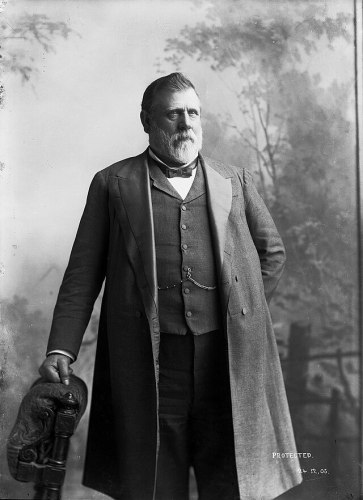
Liberal politician Richard Seddon was not a fan of giving women the vote. Their temperance movement meddling threatened to interfere with the free market and menfolk’s freedom to drink themselves to oblivion.

There is a lot in the Liberal ‘family of ideas’ that modern-day citizens can relate to and support. Most of us probably think that democratic government and equality before the law is good.*

But where it gets complicated is the ideological tenet of maximising freedom of choice – again at first blush this sounds all very jolly hockey sticks, but it has a more sinister side. In economic terms, this tenet translated into the principal of laissez-faire – that is, not interfering in the free market. It also translated into unfettered protection of private property rights – or in the parlance of our current coalition government ‘the enjoyment of property rights’. This is the basis of neoliberalism, the ideology that shapes our political economy today.

Back in the 19th century United Kingdom, by mid-century, both the more conservative Tories and the more radical Whigs had been captured by the thrall of free markets and laissez-faire – but it was the Whig government that took it to its extreme – even where thousands of lives were at stake.

When the Great Famine broke in 1845, the Tory government was in power, headed by Robert Peel (most famous for the establishment of modern policing in the UK – and why the police are affectionately called ‘bobbies’ in the UK). While ultimately inadequate for the scale of catastrophe, Peel did make some efforts to provide relief to the starving poor in Ireland. For instance, he arranged for the importation of corn (maize) from the US and tried to repeal the ‘corn laws’, which imposed tariffs on imported grains, keeping prices artificially high. But facing unsurmountable opposition he resigned, and in 1846, a Whig Government took power, headed by John Russell. This government believed that individuals should be allowed to pursue their own interests to the greatest extent possible with minimal government interference –  by providing relief through cheaply sold imported corn, the government was interfering with the market, so this had to be stopped. Equally, the government could not countenance stepping in to stop the flow of food exports from Ireland: throughout the period of the famine, the export of large quantities of grain and livestock out of Ireland continued, mainly to England. Government relief was stopped and it was left to landlords and charitable organisations to deliver relief.  In the end, about a million Irish starved to death or died of sickness associated with malnourishment. A further one and two million Irish emigrated.

Ultimately, many politicians and government officials alike believed that the Irish people had brought this misfortune upon themselves. Charles Trevelyan, the official in charge of the famine response, declared: ‘[The Famine] is a punishment from God for an idle, ungrateful, and rebellious country; an indolent and un-self-reliant people. The Irish are suffering from an affliction of God’s providence.’

By now this may all be sounding vaguely familiar. A dominant ideology in our own society is that hard-working New Zealanders should not be giving up their precious dollars for poor people who are doing too little to help themselves. If people don’t live in adequate housing or haven’t got enough money to feed or clothe their kids, it is because they are lazy, or make bad choices or [pick another reason]. This ignores the structural reasons for inequality in our society – some more recent, and some more historical (hint: colonisation, land dispossession). In Ireland, the root cause of the famine was not the potato blight but the gross inequality in ownership and access to land, the consequence of hundreds of years of conquest, land confiscation and dispossession.
In my book ‘An Uncommon Land’, I argue that many of the challenges we face today come back to land, our attitudes towards it (as the ultimate form of private property) and our efforts to accumulate as much as possible of it, to the exclusion of others. Indeed, as Bernard Hickey argues with deliberate but not totally inaccurate hyperbole, the New Zealand economy is ‘a property market with bits tacked on’.

In this laissez-faire inspired political economy, we have been encouraged – indeed rewarded – in our efforts to amass as much wealth as possible. Self-interest is Good. Caring about the wellbeing of wider society, future generations or the planet we depend on is Woke. We see this mentality with brutal clarity in the election result in the United States. We are also seeing worrying signs of it here in New Zealand’s politics. But I am optimistic that we are better than that. I hope that as a society we are willing to question our beliefs about what is really important in our economy and society. Because the future literally depends on it.

* But even something as wholesome-sounding as ‘equality before the law’ has a sinister side. It is this principle of Libertarianism that provides the rationale for the current coalition government’s efforts to subvert and undermine te Tiriti as a founding constitutional document of this country.


Why our economy is too important to leave to the experts

Image courtesy Newsroom

In this latest piece on Newsroom, I argue that it is time we democratised economics and work towards designing an economy that works for people and the planet, not the other way around.

Imagine a day when you tune into the financial news and the announcer reports:

“Share markets have plummeted to historic lows overnight with more of the world’s mega-corporations losing investor confidence. Investors are flocking instead to promising social enterprises, citing pressure from grandchildren who would rather inherit a liveable planet than a private jet.

“In New Zealand, the Domestic Happiness Index (DHI) is continuing its strong upwards trajectory and our national contribution to the Planetary Overshoot Index (POI) is trending downwards. This mirrors global trends, and leading ecological economic commentators are bullish, predicting that we may still have a liveable planet in 2050.”

Just imagine.

This scenario may not be as far-fetched as we first think. But for it to happen, we must be part of redesigning an economy fit for the 21st Century.

Continue reading on Newsroom.

A post-growth future: the pathway away from environmental collapse

Many of us are aware by now that we are facing multiple crises: climate change being just one – warming and acidifying oceans, depleted soils, global habitat and biodiversity loss are among the others in this ‘polycrisis’. The Auckland floods have made us acutely aware of how vulnerable our cities are to the ravages of extreme weather, events predicted to become more extreme and frequent as the effects of climate change bed in.

We know that this is not going to get better any time soon. There will be more floods, droughts and other weather events that will cause destruction, economic loss and human distress on a scale that we cannot yet imagine. Even the issues that affect us day to day, such as the cost of living, have at their root the unsustainability of our current economic system.

The realisation is dawning among many of us that we cannot solve this problem following the same path that led us here – that is, an extractive growth-oriented economy dislocated from the realities of a finite planet.

Read the article on Newsroom.

The bleak realisation of failure – parenthood in the face of a climate-disrupted future

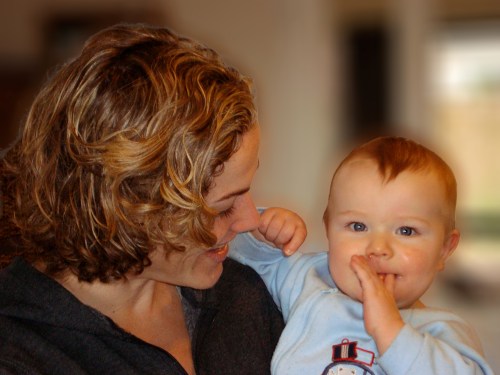
Me with Carter, aged 11 months

[Originally posted on http://www.catherineknight.nz on 18 November 2022]

I have made a bleak realisation. I am a failure. I have failed at the single most important role in my life – to safeguard the future for my children.

This has been an awful realisation to make, and it crystallised when my 14-year old son, after listening to some climate-related report on the radio said, ‘We are doomed, aren’t we, Mum?’. Unusually for him, there was not even a hint of facetiousness or irony – he was quite sincere.

At that moment, a bit of my heart shattered into pieces.

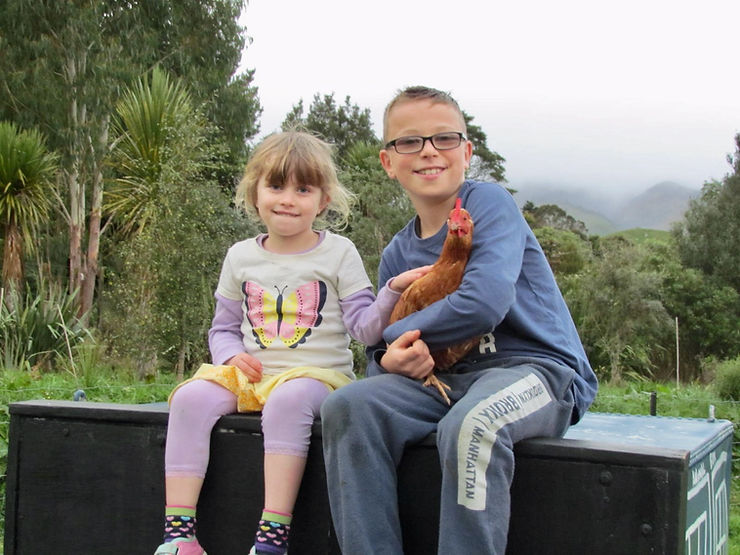
Carter and Caitlyn with Rosie the chicken. What will their future hold?

We now face the growing certainty that we will breach the 1.5 degree warming threshold that may have enabled us to avoid catastrophic and irreversible climate change. We have been warned that accelerating climate breakdown will lead to more severe and frequent climate disasters, ecological collapse, economic and social breakdown and unimaginable human suffering, including starvation, illness, displacement and death.

Or as UN Secretary-General Antonio Guterres so starkly put is a few days ago, ‘we are on a highway to climate hell’ with the option to cooperate or, enter a collective suicide pact, and perish.

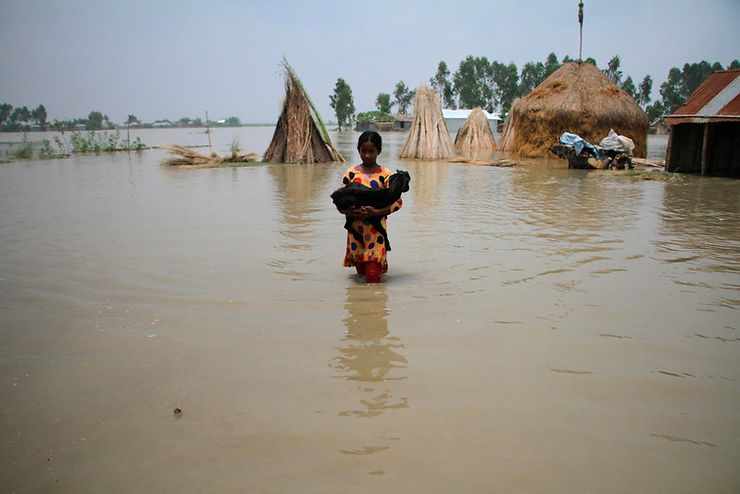
A girl carries a goat through floodwaters in Bangladesh. Climate Outreach.

Even if my children do not experience the worst of this ‘climate hell’ first-hand, they will see it unfold in parts of the world, including the ‘global south’, most vulnerable to climate disruption.

Carter playing his beloved uke, Pippa by his side, under the macadamia nut tree.

As parents, we have worked to equip our children with the skills and attributes they will need when their time comes to navigate the adult world, and hopefully help make it a better place: critical thinking skills, a basic understanding of democratic process, compassion and empathy, and self-belief, especially when they hold views different from others.

And as a parent, I can only hope that this will be enough to weather the climate storm ahead.

Protecting our future: do we need to fundamentally re-evaluate the way we live our lives?

Photo: Pexels – Pixabay

[First published on www. catherineknight.nz on 16 November 2022]

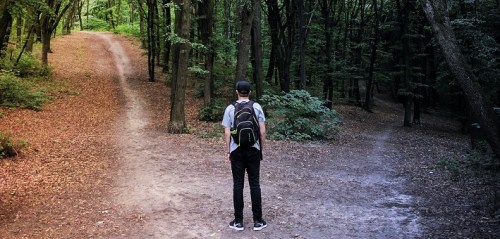
Is it time we re-evaluated our obsession with perpetual growth and shifted our focus to building a society that puts human wellbeing at its centre?

The signs that we have breached multiple biophysical boundaries are becoming harder to ignore. Climate scientists say that we have missed the opportunity to limit global warming to below 1.5 degrees and predict that the world will breach this critical threshold in the next few years. Unprecedented biodiversity loss, marine and freshwater degradation are well-documented. In recent weeks, researchers reported that 75% of fish caught in New Zealand’s southern seas contained microplastics.

For a while now, we have been reassured that if we cannot reduce our emissions as much as we need to, offsetting will take care of the rest – mainly through tree-planting. But this is a fairytale – a convenient one for industry and consumers alike. A tree planted now will not be sequestering carbon at anywhere near its peak rate for many years; meanwhile we continue to pump out climate pollution. Forests are also at increasing risk of fire due to a heating climate, or can simply be harvested – wiping out their sequestration capacity. Recently, Climate Commissioner Rod Carr condemned this strategy as ‘plant and pollute’.

But we can just switch our fossil-fuel guzzling habits to other more sustainable energies, and all will be well, right? Not quite, because there is the issue of net energy. At peak abundance, it took something like one unit of energy to produce 100 units of oil, but alternative energy sources – including hydropower, solar and wind – have a significantly lower energy return. Biofuels perform especially poorly – at 3 or less units of energy for every one consumed by some assessments. So producing enough energy to maintain our energy-hungry lifestyles will require a huge expansion of the energy sector, with all its associated environmental costs.

Photo: Pexels – Jose Francisco Fernandez Saura

Meanwhile, in New Zealand, our per capita energy consumption (in oil equivalent terms) has been on a relentless rise – tripling since the 1960s – despite all our ‘energy-saving’ devices.

The reality is simple. The continued pursuit of growth is not viable; we cannot continue consuming and throwing stuff away at the rate we are. We are already in breach of multiple biophysical limits – climate being just one – and the technological salvation we have been waiting for is nowhere in sight.

To a growing number of New Zealanders, the way forward is clear. To reduce emissions and our environmental impacts, we must reduce our consumption. Some call this idea de-growth, but this has the obvious disadvantage of sounding like a deficit. In my eyes, this is the wrong way to think about it. I believe that a shift from our obsession with economic growth and its mythical ‘trickle down’ effect, to one where human and environmental wellbeing is central, would be a path to plenitude – of improved wellbeing, time with family and friends, connection with community, time to move, have fun and be in nature.

I grew up in the 1970s. Our family had no car, we walked or biked everywhere, and occasionally took a bus; most of our clothes were hand-me-downs; we grew our own vegetables; if something broke we fixed it; we spent most of our time playing creatively or outside – not with expensive devices. Did I feel deprived or hard done by? No – we had everything we needed for a good life.

I am not suggesting we turn back time and eschew technology, Amish-like, but rather think about what we really need for a good life. When looking back on their lives, few people will regret not having the latest Smart TV or getting that status-enhancing but stress-inducing promotion. Most people will regret things like not spending more time with their kids, or not prioritising their health over work.

Photo: Pexels – Creation Hill

Whatever we call it: degrowth, steady state economy, wellbeing economy or ‘new economics’, the time to fundamentally reassess what is important to us, both individually and as a nation, is now. Is it growth, mass consumption, convenience; or is it wellbeing, connection, and time to spend with those we love?