‘Unafraid to tackle the pressing moments of our past, present and future’
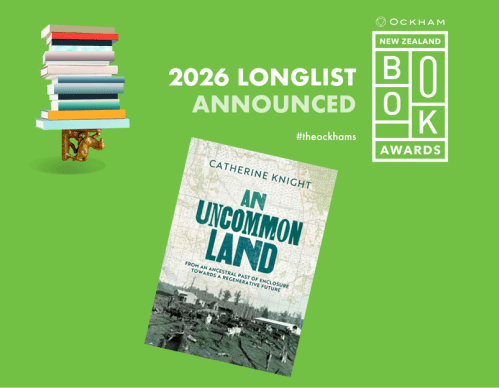
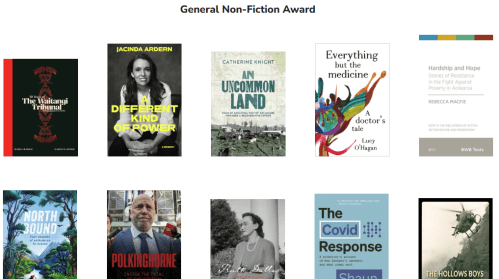
It is not every day I stand next to a former Prime Minister, let alone one as world renowned as Jacinda Ardern, but there I am – at least virtually – in the line-up for the Ockham New Zealand Book Award’s General Non-fiction Award. Alongside twelve other books by such literary luminaries and fearless writers as Tina Makeriti, Steve Braunias and Rebecca MacFie.
The media release describes the longlist’s authors as ‘authors are unafraid to tackle the pressing moments of our past, present and future’ … which seems so apt.
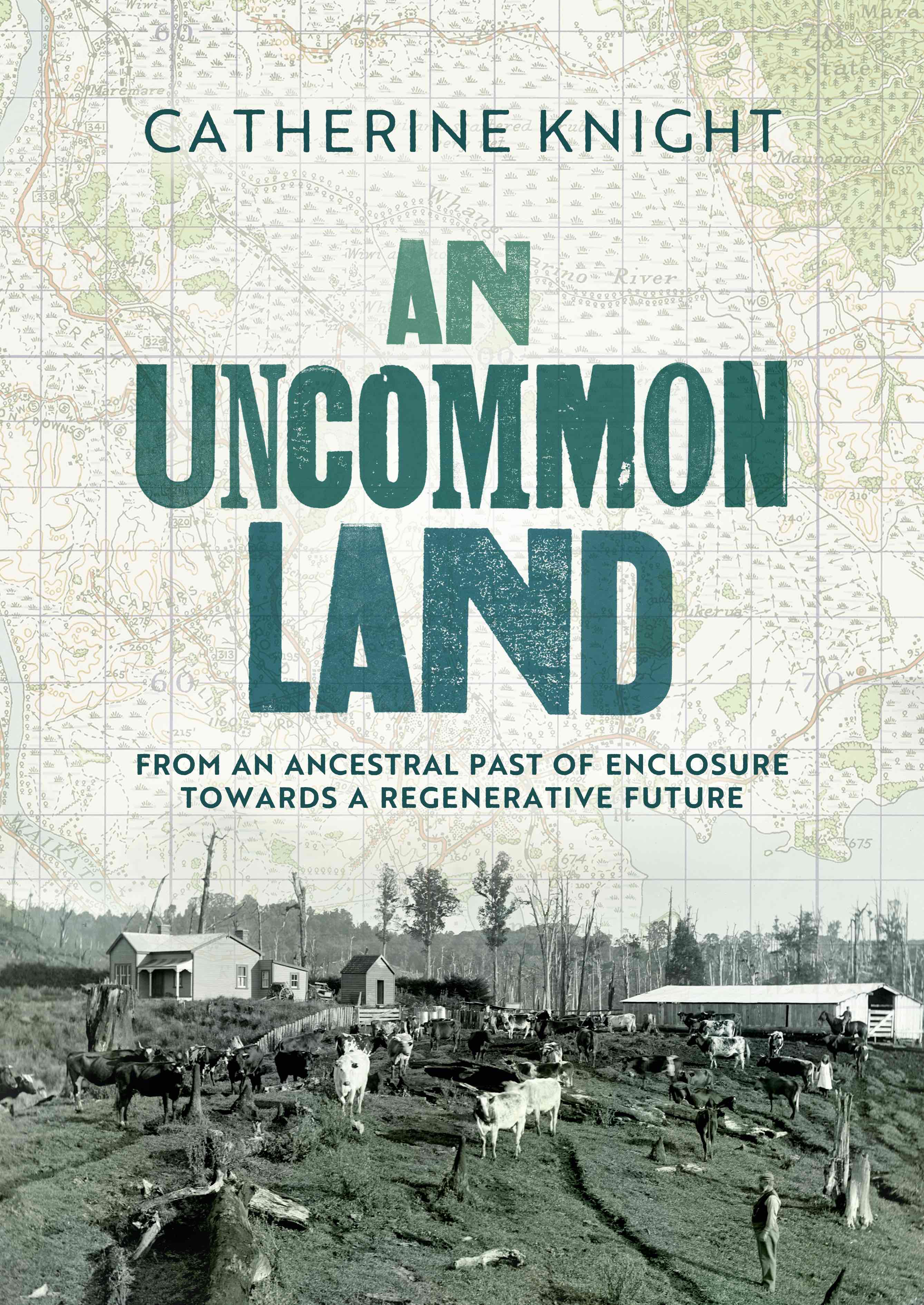
‘An Uncommon Land’ is all about the connection between past, present and future – and facing the future with vision and courage. As the back cover blurb notes:
‘An Uncommon Land’ is a story of enclosure, dispossession, colonisation and – ultimately – hope for a better future. Through the lens of her ancestors’ stories, Catherine Knight throws light on the genesis and evolution of the commons, its erosion through enclosure and the ascendency of private property in parallel with the rise of capitalism – a history that has indelibly shaped New Zealand society and its landscape...
At this pivotal juncture in our history, we face unprecedented challenges caused by our exploitative actions towards nature and each other. But we have a choice: to continue along the path of untrammelled exploitation and exponential growth, or to reassess the way we engage with the natural world and the rest of society. From a past of enclosure, resource exploitation and denaturing, we could choose a path of re-commoning and regeneration, taking inspiration from our collective history.
As we head into a year that already has all the tell-tale signs of a world unravelling, it is reassuring to know that there is a growing recognition of the need to re-evaluate our future, and of those voices calling for this. That work needs to start now, with urgency, and because our political leaders have abrogated their responsibility to ensure the future welfare of New Zealanders in the face of the escalating polycrisis, it is clear that it needs to be led by civil society.
Further musings on Lord Palmerston, the Great Irish Famine and the future of society
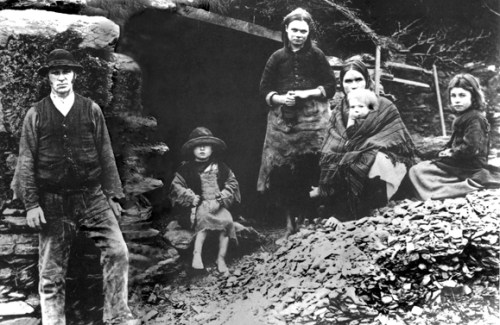
A family during the Great Famine
In my last post I talked about the man behind the name of not one but two urban centres in New Zealand, Henry John Temple, better known by ‘noble’ title, Lord Palmerston. I wrote about his inhumane treatment of impoverished and starving Irish tenant farmers on his bounteous estates in Sligo, north-eastern Ireland. His main focus was ridding himself of this wearisome burden, so he (literally) shipped them off to North America. Many died agonising deaths from malnutrition and illness on the way, or once they got to their destination.
In this post I am keen to explore another aspect of this history – a political ideology that has had tremendous influence on our political economy and our lives today. That is, Liberalism. (Noting that its derivative ‘Libertarianism’ is related but distinct in some critical ways but will not delve into this here.)
Because, as well as being a wealthy landlord with questionable morals, and the namesake of several places in ‘the colonies’, our man Lord Palmerston was also the first Liberal Prime Minister. The Liberal Party was first formed in 1859 when the Whig party – the main rival to the more conservative Tories – merged with a couple of other parties with equally radical ideas.
So what is Liberalism? The Concise Oxford Dictionary of Politics tells us that generally speaking it is ‘the belief that it is the aim of politics to preserve individual rights and to maximise freedom of choice.’ More particularly, the Liberals espoused rights of the individual, liberty, political equality, right to private property, and equality before the law. In New Zealand, the first Liberal government premier, Irish-born John Ballance, supported women’s suffrage (in principal anyway) though many of his Liberal colleagues were opposed. (Most notably, Richard Seddon – subsequent prime minister – strongly opposed women’s suffrage because it would be detrimental to the liquor trade, which he had strong alliances with.)
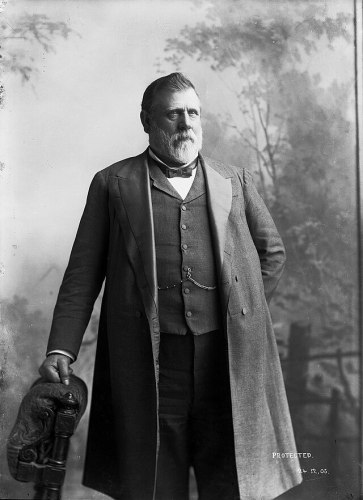
Liberal politician Richard Seddon was not a fan of giving women the vote. Their temperance movement meddling threatened to interfere with the free market and menfolk’s freedom to drink themselves to oblivion.
There is a lot in the Liberal ‘family of ideas’ that modern-day citizens can relate to and support. Most of us probably think that democratic government and equality before the law is good.*
But where it gets complicated is the ideological tenet of maximising freedom of choice – again at first blush this sounds all very jolly hockey sticks, but it has a more sinister side. In economic terms, this tenet translated into the principal of laissez-faire – that is, not interfering in the free market. It also translated into unfettered protection of private property rights – or in the parlance of our current coalition government ‘the enjoyment of property rights’. This is the basis of neoliberalism, the ideology that shapes our political economy today.
Back in the 19th century United Kingdom, by mid-century, both the more conservative Tories and the more radical Whigs had been captured by the thrall of free markets and laissez-faire – but it was the Whig government that took it to its extreme – even where thousands of lives were at stake.
When the Great Famine broke in 1845, the Tory government was in power, headed by Robert Peel (most famous for the establishment of modern policing in the UK – and why the police are affectionately called ‘bobbies’ in the UK). While ultimately inadequate for the scale of catastrophe, Peel did make some efforts to provide relief to the starving poor in Ireland. For instance, he arranged for the importation of corn (maize) from the US and tried to repeal the ‘corn laws’, which imposed tariffs on imported grains, keeping prices artificially high. But facing unsurmountable opposition he resigned, and in 1846, a Whig Government took power, headed by John Russell. This government believed that individuals should be allowed to pursue their own interests to the greatest extent possible with minimal government interference – by providing relief through cheaply sold imported corn, the government was interfering with the market, so this had to be stopped. Equally, the government could not countenance stepping in to stop the flow of food exports from Ireland: throughout the period of the famine, the export of large quantities of grain and livestock out of Ireland continued, mainly to England. Government relief was stopped and it was left to landlords and charitable organisations to deliver relief. In the end, about a million Irish starved to death or died of sickness associated with malnourishment. A further one and two million Irish emigrated.
Ultimately, many politicians and government officials alike believed that the Irish people had brought this misfortune upon themselves. Charles Trevelyan, the official in charge of the famine response, declared: ‘[The Famine] is a punishment from God for an idle, ungrateful, and rebellious country; an indolent and un-self-reliant people. The Irish are suffering from an affliction of God’s providence.’
By now this may all be sounding vaguely familiar. A dominant ideology in our own society is that hard-working New Zealanders should not be giving up their precious dollars for poor people who are doing too little to help themselves. If people don’t live in adequate housing or haven’t got enough money to feed or clothe their kids, it is because they are lazy, or make bad choices or [pick another reason]. This ignores the structural reasons for inequality in our society – some more recent, and some more historical (hint: colonisation, land dispossession). In Ireland, the root cause of the famine was not the potato blight but the gross inequality in ownership and access to land, the consequence of hundreds of years of conquest, land confiscation and dispossession.
In my book ‘An Uncommon Land’, I argue that many of the challenges we face today come back to land, our attitudes towards it (as the ultimate form of private property) and our efforts to accumulate as much as possible of it, to the exclusion of others. Indeed, as Bernard Hickey argues with deliberate but not totally inaccurate hyperbole, the New Zealand economy is ‘a property market with bits tacked on’.
In this laissez-faire inspired political economy, we have been encouraged – indeed rewarded – in our efforts to amass as much wealth as possible. Self-interest is Good. Caring about the wellbeing of wider society, future generations or the planet we depend on is Woke. We see this mentality with brutal clarity in the election result in the United States. We are also seeing worrying signs of it here in New Zealand’s politics. But I am optimistic that we are better than that. I hope that as a society we are willing to question our beliefs about what is really important in our economy and society. Because the future literally depends on it.
* But even something as wholesome-sounding as ‘equality before the law’ has a sinister side. It is this principle of Libertarianism that provides the rationale for the current coalition government’s efforts to subvert and undermine te Tiriti as a founding constitutional document of this country.
Exploring enclosure, colonisation and denaturing through an ancestral past, towards the possibilities of a re-commoned future
This week, after about four years of working intermittently on my latest book ‘An uncommon land’, I handed over my manuscript to my trusted editor. I have been released (for a while at least) from the research and writing that has been all-consuming over the last months. This is when the exciting phase of transformation begins: taking pages of painfully pored-over words and a ragtag collection of images, and crafting them into a book. And, I get to start talking with people about the ideas and reflections that have until now been confined to my mindscape and to the Word doc on my screen.
‘An uncommon land’, the title of my book, has dual meaning – one meaning that points to the past, and one meaning that points to the future. I will expand on this in subsequent posts. But, as a taster, here is a blurb about my book:
‘An uncommon land’ is a unique exploration of New Zealand’s history using the experience of the author’s ancestors as a lens. In this engaging and richly illustrated book, award-winning author and environmental historian Catherine Knight throws light on the genesis and evolution of the commons, its erosion through enclosure, and the ascendency of private property in parallel with the rise of capitalism – a history that has indelibly shaped New Zealand society.
Like other European settlers, the lives and future prosperity of the author’s ancestors had their foundations in war, land appropriation, and environmental destruction, but in their stories there are also glimmerings of the potentiality of commons – tantalising hints of an alternative path to a re-commoned, regenerative future.
This book comes at a pivotal juncture in our history: the last two centuries have been characterised by land enclosure, the unconstrained destruction of nature, and capital accumulation. As we face unprecedented challenges caused by our exploitative actions towards nature and each other, we have a choice: to continue along the path of exponential growth, or to reassess the way we engage with the natural world and the rest of society. From a past of enclosure, resource exploitation and denaturing, we could choose a path of re-commoning and regeneration, taking inspiration from our collective history.
Over the next weeks and months, I intend to explore the themes traversed in the book through some short writings on Substack. The topics will be wide-ranging and probably somewhat random and unpredictable (even to me). I hope you will join me on this unpredictable, exploratory – and hopefully, thought-provoking – journey from the past into the vast potentiality of a different kind of future.
In this piece for the Kākā, I argue that this election is big on marketing strategy and slogans, but appreciably thin on vision. And it is a marketing campaign largely based on the assumption that the voter is Homo Economicus – that is, a person who makes decisions exclusively guided by self-interest. But my sense is that, despite what politicians think, New Zealanders do care about the world beyond their own economic status – and a growing number of us are acutely aware that the growth-based economy is not working for either people or the planet. But New Zealanders are not being given the chance to contemplate an alternative future because no one in any position of influence is talking about it. Our politicians are too pre-occupied with their desperate appeals to Homo Economicus.
We can’t consume our way out of the climate crisis. Photo courtesy The Kaka.
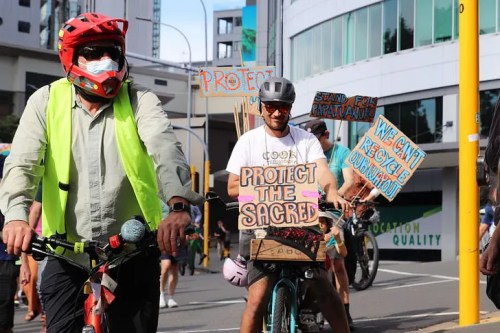
This week I chatted with journalists Bernard Hickey and Cathrine Dyer about the economics of sufficiency on The Kaka. We covered a lot of ground, including why recycling and buying an electric car won’t quite cut if we want to curb combat climate change, the limits of the renewable energy transition, and the idea of putting sufficiency ahead of GDP growth as the central policy goal for our economy.
Listen to and read more about the conversation here.
It is my pleasure and privilege to be presenting this upcoming seminar hosted by the School of People and Environment, Massey University. In the seminar I will be expanding on themes explored in my articles on Newsroom, which can be found at this link.
For those who missed the seminar, here is a link to the recording (passcode: 0U3PW@sA).
‘Collapse’ – the complete breakdown of society as we know it. Photo: Newsroom
Is there anything more terrifying than the prospect of global collapse in the near future? Yes, undoubtedly: the possibility that collapse is already happening but we just don’t realise it.
‘Collapse’ used as a simple unmodified noun refers to the complete breakdown of society as we know it. It may be precipitated by climate change, but it could also be triggered by any number of other crises, including another, even more brutal pandemic than Covid-19, a global financial crash or sudden energy disruption. Or a combination of some or all of these.
The cause is almost academic, because all of these things are related. They are all symptoms of a single problem, which is that humans (and especially high-income nations) are overshooting the planet’s ability to regenerate and self-regulate, fuelled by the one-off bonanza of fossil fuels, which have allowed us to produce and consume more (and pollute more) than any other time in history.
A hundred years ago many New Zealanders were content with a bowl of porridge in the morning made from oats produced in Southland and Otago. Photo: Newsroom.
My latest article on Newsroom asks what if we made sufficiency a central guiding principal of our economy, as countries such as France are starting to do? It draws on earlier advocacy of the late Jeanette Fitzsimons, who argued for an ‘economy of enough’.
On one autumnal afternoon in 2013, the late Jeanette Fitzsimons addressed a hall full of people in the leafy town of Waikanae on the Kāpiti Coast. Unusually, for a former academic and seasoned politician, she began her address with a story about a certain slow-witted but very likeable bear – who had indulged in a bit too much honey while visiting his friend Rabbit and got stuck in Rabbit’s doorway on his way out.
In the story much discussion ensued on ways to resolve this predicament, including Rabbit moving to a bigger tree, or cutting a bigger doorway. But in the end it was Christopher Robin who sagely concluded, “Pooh, you will just have to stay there and not eat any more until you lose weight”.
Through this story, Fitzsimons was deftly providing an analogy for the current human predicament. She went on to describe the need to transition to an “economy of enough”. That is, rather than Rabbit upsizing to allow for more honey consumption, Pooh just needed to cut back a bit. He needed to understand how much honey was enough and be satisfied with that.
Ten years have passed, and the need to transition to an economy of enough has only become more urgent. The words “overshoot”, “polycrisis”, “metacrisis” and “collapse” are now scattered through everyday conversations in lecture halls, meeting rooms, cafes and living rooms around the country as our awareness of the situation deepens.
I originally pitched this short opinion piece to Stuff to follow on from an earlier piece on degrowth. However, when I submitted the finished piece, the editor declined to publish, stating that ‘it was too like other pieces published lately’ and that the audience had reached saturation point on green growth and degrowth issues. (A deeply ironic statement given that almost everything published in mainstream media is supportive and unquestioning of a growth-oriented narrative.) I also felt it would be prescient given the upcoming debate on degrowth versus green growth hosted by University of Victoria.
In light of Stuff publishing this opinion piece in response to the debate, in which the author seems to be calculatedly stirring up Red Menace anxieties reminiscent of the Cold War era by selectively cherry-picking the likes of Marxist scholar Kohei Saito’s writings as if representative of degrowth scholarship, I thought I needed to get my original piece out there one way or another.
As I have argued previously, for the future of our country and our planet, we urgently need a mature and evidence-based discussion. This kind of fear-mongering (degrowth is a thinly-veiled Marxist plot and without growth we will no longer have cancer drugs or dialysis machines) and sneering academic elitism (‘degrowth is intellectually chaotic’ – not to mention one of its main advocates is an anthropologist who believes he has expertise on the economy!?) certainly fulfils mainstream media’s desperation for click-baity headlines, but does nothing to progress a reasoned, open-minded debate on arguably the most important issue of our time.
As I have argued elsewhere, every New Zealander has a right to have a say on the future of our economy and our planet – this should not be be the preserve of economists institutionalised within government or academia. So here is the piece that Stuff refused to publish.
A growing number of New Zealanders are expressing deep concern about climate change, particularly as recent extreme weather events on our shores show that this is no longer a remote issue that only affects people in other countries. It is affecting us here, now: destroying homes and livelihoods, disrupting communities, causing heartbreak and distress, and in the most tragic cases, loss of life.
But despite our growing concern, many of us remain quietly optimistic about the future – reassured by daily offerings from mainstream media filled with stories of innovators developing new technology that will instantly create clean energy, suck up carbon dioxide by the truck-load, and turn waste into energy or other useful things like car-seat covers. The message is, we can carry on living the energy- and resource-intensive lives we do now because clever scientists, innovators and tech geniuses will find a way out of this.
Green growth adds to the bright shiny promise that we can keep on living the way we do now (using resources at a rate equivalent to one and three-quarter Earths). Green growth promises that we can carry on pursuing growth (after all, if we don’t have growth, how will we pay to fix all the damage we are causing?) – all we need to do is decouple it from greenhouse gas emissions and other environmental harm. This can be done, green growth advocates tell us, by increasing productivity and efficiency, moving to a more circular economy, and reducing waste. All without making a dent in growth!
Through the Intergovernmental Panel on Climate Change (IPCC), climate scientists have delivered their final warning: we need to take bold action urgently to avert the untold environmental and human tragedy of irreversible climate breakdown. So, if the promise of green growth (or its affable cousin, ‘sustainable growth’) hasn’t been realised yet and there is no evidence that it will at the rate and scale required, isn’t it time we gave up on that idea and moved on to something that does give us – and more importantly, our children and their children – a chance?
That ‘something’ is degrowth. If that sounds a bit subversive, steady-state economy, doughnut economics or wellbeing economy are other economic models that embrace the same foundational principle: that is, an economic system that puts human wellbeing and ecological balance at the centre, not the blind pursuit of growth.
As discussed in this earlier piece published on Stuff, degrowth does not advocate for the carte blanche downscaling of the economy as a whole – rather it argues for the upscaling of the parts of the economy that will enhance human wellbeing while reducing our impact on the planet. These sectors include renewable energy generation, public transport, education and health and care sectors, sustainable food production, energy-efficient homes and repairable long-lasting goods. At the same time, it argues for the downscaling of the parts of our economy that are damaging to the environment, with little or no benefit for our collective wellbeing – such as single-use products and designed-in obsolescence, private vehicles, air travel, fast fashion and industrialised meat and dairy production.
And it is important to remember too, that while perpetual, compounding growth, as measured by GDP, has become the central goal for which all ‘modern’ economies strive, it has only been so since the 1950s. Since then we have become entranced by it glittering promises of ever-growing wealth for all; simultaneously blinded to all the damage that our ever-expanding global economy is doing to our planet’s seas, forests, freshwaters, atmosphere and – ultimately – to our descendants’ chances of being able to lead flourishing, fulfilling lives.
Isn’t it time we found another guiding star for our economy – that of wellbeing for all, including the living things we share this planet with?












 envirohistory NZ