Bridge to nowhere – a battle with nature lost

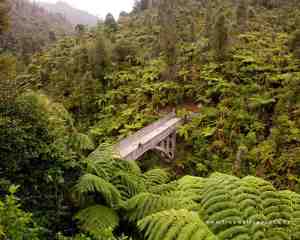
Not all struggles to tame the land in New Zealand have been successful ones. The failed attempt to settle Mangapurua, (now part of the Whanganui National Park) is a battle that nature won – and the Bridge to Nowhere is a poignant symbol of human defeat.

Under the Discharged Soldiers Settlement Act 1915 and further legislation in 1917, over 10,000 veterans of the First World War were assisted onto land. Some 3,000 of these were settled on Crown land, much of it marginal and remote central North Island land. Over 5,000 veterans took up government loans to buy and develop properties, while others took up leases of Crown land under various forms of tenure.

Mangapurua (click here to view map) was one of the settlements opened up for soldiers returning from the war. The land was infertile, steep and prone to erosion because the bush had been cleared. A slow migration of soldier settlers out of the district began after the 1921 crash in agricultural prices, with the last settlers leaving in 1942. A bridge – known as ‘the bridge to nowhere’ – over the Mangapurua Gorge is one of the few traces of the former settlement. [Source: Te Ara Encyclopedia of New Zealand]

Watch a TV6 video about the Bridge to Nowhere (including spectacular forest scenery) here.

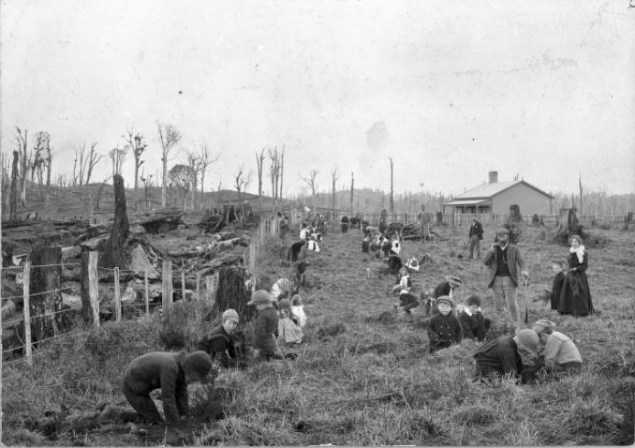
The ultimate paradox?

Children at Toko Primary School, Taranaki, planting trees on Arbor Day 1900. In the fields around them, the devastating effects of the milling and burning of forest that was occurring throughout the country can clearly be seen. [Photo not to be reproduced without the permission of Alexander Turnbull Library, ref 1/2-003378-F. Acknowledgments to David Young for sharing this poignant photo in Our Islands Our Selves.]

From “swamps” to “wetlands”

Through time, not only has our environment been transformed, but also the way we perceive it and the words we use to describe it. No example illustrates this better than the “swamp” to “wetland” transformation. When European settlement of New Zealand began in earnest about 150 years ago, about 670,000 hectares of freshwater wetlands existed. By the 20th century, this had been reduced to 100,000 hectares. Continue reading

Destruction of our forests over time

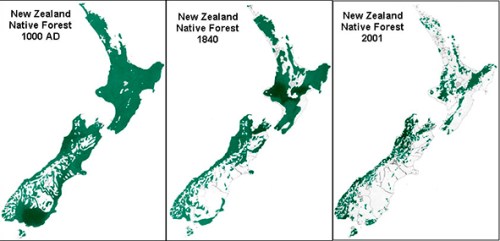
Prior to human colonisation, it is thought that the New Zealand landmass was almost entirely covered in forest, apart from alpine areas. Between the beginning of Polynesian settlement in New Zealand around the fourteenth century and the beginning of organised European colonisation in the nineteenth century, it is estimated that forest cover was reduced by about half, largely through fire. When the European settlement of New Zealand began in earnest in the 1840s, it is estimated that forest, or ‘bush’ in the vernacular, covered about two thirds of the North Island and about 25 to 30 per cent of the South Island. In the decades that followed, bush was destroyed through milling and fire to make way for settlements and farms. By 1900, forest cover had been reduced by half again, to about 25 per cent.

Figure (below): Forest cover AD 1000, 1840, 2001 (Source: Kiwi Conservation Club)