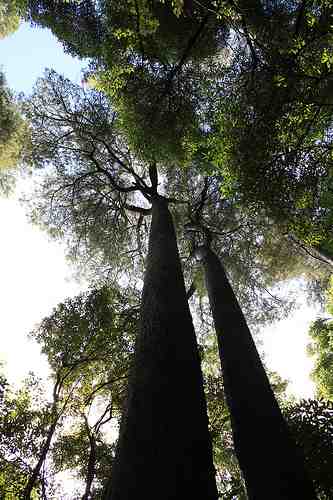
 New Zealand’s tallest forest tree, the kahikatea (Dacrycarpus dacrydioides), once dominated the forests that covered much of New Zealand’s swampy lowland areas. Far from a solitary tree, the kahikatea groups closely with other kahikatea, intertwining its buttressed roots with its neighbours for support in the unstable swampy ground. (It is perhaps for this reason that the kahikatea has evolved with such a tall, straight trunk with no lower branches, to enable it to “huddle” with others for stability). In autumn, throughout the lowlands of New Zealand, numerous forest birds chattered noisily in its canopy, feeding on its abundant red berries. These berries, called koroī, were also a valued food source for Māori, who skillfully climbed up the smooth branchless trunks to harvest them. Continue reading
Month: October 2010

The conquest of the “noble” forest of Waihou
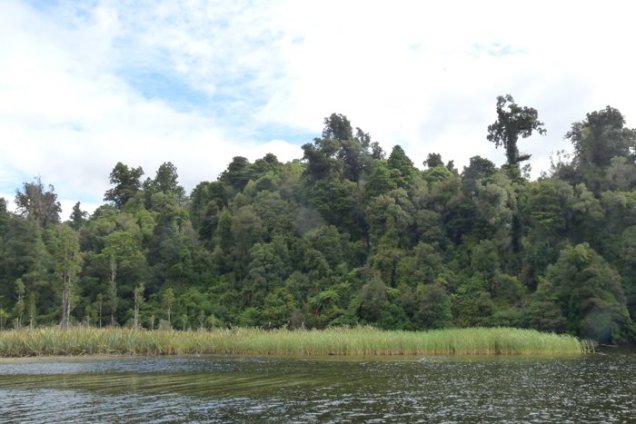
On 16 November 1769 Captain James Cook in his ship Endeavour cast anchor off Tararu Point, about 2 miles north-west of the present town of Thames [click here to view map], and made a short excursion on the Waihou River by ship’s boat. Both Cook and the ship’s botanist Joseph Banks were deeply impressed by what they saw. Continue reading
Share this:

Landscape and history
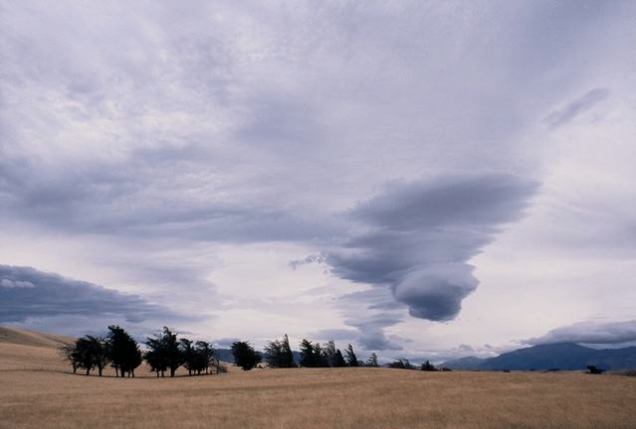 Prefacing the Introduction of Geoff Park’s masterpiece of ecology and history “Nga Uruora – Ecology and History in a New Zealand Landscape” is a quote from Frank Gohlke, American landscape photographer and writer [click here to view website]:
Landscapes are collections of stories, only fragments of which are visible at any one time. In linking the fragments, unearthing the connections between them, we create the landsape anew. A landscape whose story is known is harder to dismiss… Continue reading
Share this:

Forest clearance in 1880s New Zealand – the views of Mrs Robert Wilson
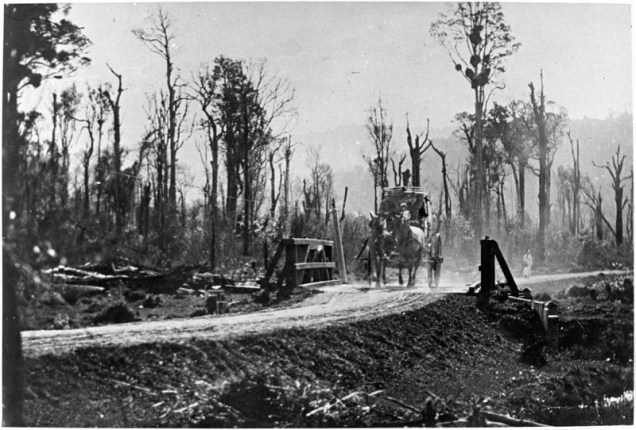
In 1962, A.G.S. Bradfield published “The Precious Years”, a sequel to his earlier book “Forgotten Days”; both books recounting stories of the “pioneering days of Palmerston North and Districts in the Manawatu”. These are charming little books, in which Bradfield draws on first-hand memories of older Manawatu residents, giving it an authenticity and poignancy that would not be achievable today, nearly half a century on. Continue reading
Share this:

The history of a little fish – whitebait decline in New Zealand
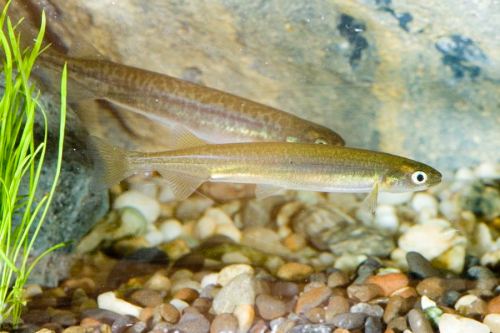 The front-page article in yesterday’s Kapiti Observer, showing a photo of a local man peering glumly into the his near-empty whitebait net at the mouth of the Waikanae River, prompted me to think about whitebait decline and its historical causes.
But first of all, what are whitebait? Many New Zealanders (including myself, until embarrassingly recently) may vaguely assume that it is a type of small fish – but in fact it is the juvenile form of five species of the fish family Galaxiidae (the most common being inanga). Continue reading
Share this:

The biscuit (or “Ode to Harriet II”)
x
Biscuit in hand
He turns to the door
Expectantly,
Head tilted, softly hooked finger pointing:
“Haait”
x
I crouch, imploringly
Looking into his questioning face
Seeking to explain;
Words my only weapon against the searing sadness.
x
See also: An ode to Harriet
See also: An ode to Harriet
Share this:

An ode to Harriet

Deep brown eyes, still vibrant
Despite the pain
Despite the indignity
Despite the crumbling limbs.
x
Moments before she left us
Those eyes looked into mine
Knowingly,
As if to comfort me. Continue reading
Share this:

Halting the great sand-drift: the “exoticisation” of our coast
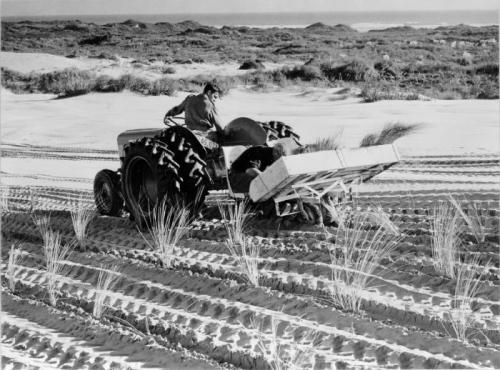 Growing up in the Manawatu, I took for granted the largely homogeneous dune landscape of Himatangi, Foxton and other west-coast beaches – oblivious to the fact that this was a primarily man-made landscape. As Raewyn Peart explains in “Castles in the Sand”, the appearance of sand dunes have been extensively modified, firstly through deforestation, and then through intensive re-stabilisation efforts from the 1930s onwards. Continue reading
Share this:

The school teacher and the egg – the remarkable story of the Taiaroa Head albatross
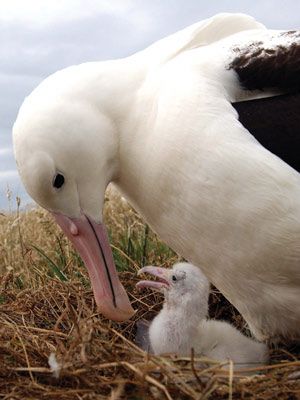 In her book outlining the history and development of the New Zealand coast, “Castles in the Sand”, Raewyn Peart relates the remarkable story of the Taiaroa Head albatross. This is a tale of determination – both of the albatross itself, and the man who decided to intervene on its (and our) behalf.
The majestic royal albatross – among the world’s largest flying birds, with a wingspan of 3 metres – nests mainly on offshore islands. Taiaroa Head, on the Otago Peninsula [click here to view map], is now the only mainland albatross nesting site in the world. However, even here, its ongoing survival has been a tenuous one.
The first recorded albatross egg laid at Taiaroa Head was found in 1920. However, before the egg could hatch, the residents of the nearby lighthouse had taken it to eat. Continue reading
Share this:

Top search terms for envirohistory NZ
 Search terms (the key words you put in Google or any other search engine to find information about a particular topic) are an important way for readers to find a particular website or web-based article. They tell you a lot about what readers of a website are interested in. And envirohistory NZ is no exception. We are really interested in what our readers are interested in!
So, what are the top search terms that brought internet users to envirohistory NZ? Continue reading

 envirohistory NZ